AI-Powered Virtual Assistant for Lead Nurturing That Never Sleeps
Written with AI assistance under our editorial guidelines
AI-powered virtual assistants now automate lead nurturing with relentless efficiency, never forgetting follow-ups or missing engagement opportunities. According to 2024 research, 60 percent of businesses adopting this technology expect increased productivity, though many underperform because AI struggles with context and true personalization. When deployed effectively, these systems engage leads automatically while freeing human salespeople to focus on complex, high-value interactions.
It used to be simple: you built your pipeline, followed up with leads, and hoped your charisma (or sheer persistence) pulled enough prospects over the finish line. Fast-forward to today, and the entire sales landscape is mutating under the pressure of relentless digital acceleration. Enter the AI-powered virtual assistant for lead nurturing—a force so disruptive it’s not just changing sales, it’s blindsiding some of the world’s most competitive teams. Beneath the glossy promises of effortless conversions and 24/7 engagement, the truth is darker, weirder, and infinitely more fascinating. What happens when your best sales rep never sleeps, never forgets, and never grows tired of following up? And what are the brutal truths sales leaders are only now beginning to confront? This deep dive uncovers what the data reveals, where the myths unravel, and how the boldest sales teams are wielding AI as both weapon and shield in the war for revenue.
What if your best sales rep never slept? The rise of AI-powered virtual assistants
Redefining lead nurturing in the age of AI
For decades, lead nurturing was a grind—a relentless slog of emails, calls, data entry, and half-remembered follow-ups that slipped through the cracks the moment humans got tired or distracted. The premise was always tantalizing: what if you could engage every prospect at the perfect moment, with the perfect pitch, on their preferred channel? Enter the AI-powered virtual assistant: not a gimmicky chatbot, but a machine-learning juggernaut designed to triage, tailor, and turbocharge the entire nurturing sequence.
Recent research from Intelliarts (2024) reveals a paradox: while 60% of businesses who adopt AI for lead nurturing expect a golden age of pipeline productivity, most still underperform. Why? Because AI, for all its predictive muscle, still wrestles with context, nuance, and true personalization. Yet, when deployed right, these assistants engage leads with ruthless efficiency—never missing a follow-up, surfacing the hottest signals, and scaling campaigns to levels no human could dream of. The very nature of sales engagement is being rewritten, and the stakes couldn’t be higher.

The shift isn’t just technological—it’s philosophical. AI doesn’t simply automate; it transforms how sales teams think about trust, timing, and human touch. The best sales pros aren’t being replaced—they’re being refocused, empowered to tackle higher-order challenges while their AI teammate handles the relentless, data-driven grind. What’s unfolding isn’t just a change in workflow, but a complete realignment of the sales-customer relationship.
How we got here: A brief (and brutal) history of lead nurturing
Lead nurturing has always been a battleground for attention. In the early days, it meant handwritten notes, rolodexes, and gut-feel timing. Then came the digital revolution—email campaigns, CRM systems, and the birth of the automated drip sequence. But each wave of technology brought its own set of problems: impersonal messaging, data silos, and “marketing fatigue” that made prospects tune out.
| Era | Dominant Method | Pitfalls |
|---|---|---|
| Manual (Pre-2000) | Handwritten, phone | Inconsistent, unscalable |
| CRM/Email (2000–2015) | Mass email, basic CRM | Generic, easy to ignore |
| Marketing Automation | Drip campaigns | Fatigue, low personalization |
| AI-Powered (2019–Now) | Predictive, adaptive AI | Overreliance, privacy concerns |
Table 1: The evolution of lead nurturing—progress or just new headaches?
Source: Original analysis based on Intelliarts (2024), Software Oasis (2024), and ZipDo (2024)
Despite flashy promises, each era delivered both progress and pain. The leap to AI-powered virtual assistants represents more than just a new tool—it’s the first time machines are being asked to interpret, anticipate, and act on human intent at scale. The move is as much about overcoming old failures as it is about engineering new victories.
Shocking statistics: What your competitors already know
Behind the marketing headlines, the numbers are both a warning and a wakeup call. Over 40% of U.S. small and medium businesses have now adopted some form of AI assistant, according to ZipDo (2024). Yet, a staggering 60% of all businesses still underperform in lead generation, even after adding AI into the mix (Intelliarts, 2024). The gap isn’t about technology—it’s about execution, integration, and honest self-assessment.
| Statistic | Source / Year | Key Takeaway |
|---|---|---|
| 60% underperform in lead generation with AI | Intelliarts, 2024 | AI isn’t a silver bullet |
| 67% increase in sales engagement via AI | Software Oasis, 2024 | Engagement spikes—but so do risks |
| 40%+ US SMBs now use AI assistants | ZipDo, 2024 | Mainstream acceptance, rising stakes |
| Virtual assistant market: $20.21B in 2024 | Coolest Gadgets, 2024 | The industry is exploding |
Table 2: AI-powered lead nurturing by the numbers
Source: Intelliarts (2024), Software Oasis (2024), ZipDo (2024), Coolest Gadgets (2024)

The brutal truth: adopting an AI-powered virtual assistant for lead nurturing won’t save a broken strategy—it will amplify whatever foundation you’ve already built. Best-in-class teams wield AI as a force multiplier, not a crutch. Everyone else risks automating mediocrity at scale.
Human vs. machine: The uncomfortable truth about AI and sales relationships
Why the ‘human touch’ isn’t always best
For years, “relationship selling” was the gospel. Sales trainers preached that trust, empathy, and the personal touch sealed deals. But in an era of information overload, is “being human” enough—or even desirable? According to recent research from Software Oasis (2024), AI assistants are outperforming humans in responsiveness, consistency, and even perceived helpfulness in initial outreach.
“It’s ironic, but sometimes AI’s lack of emotion actually removes friction. Prospects feel less pressure, more control, and get answers instantly. The result? They actually trust the process more—at least in the early stages.” — Dr. Lena Mohan, Sales Automation Specialist, Software Oasis, 2024

This isn’t to say humans are obsolete—far from it. But the idea that the “human touch” always trumps technology is being upended by hard data. In fact, the relentless consistency of AI is now seen as an asset, not a liability, especially in the noisy, distracted world of digital sales.
Where AI blows humans out of the water (and where it fails)
AI-powered virtual assistants excel at tasks that drive most salespeople to burnout: timely follow-ups, data triage, and personalized but repetitive outreach. But the technology isn’t perfect. AI still struggles with complex qualification, nuanced objections, or reading subtle cues from a skeptical prospect. According to Intelliarts (2024), while AI can boost engagement rates by 67%, it requires human oversight for complex decisions and deal-closing finesse.
| Superpower (AI) | Where AI Triumphs | Where Humans Still Rule |
|---|---|---|
| Consistency | Never misses a follow-up | Handles delicate objections |
| Scalability | Manages 1000s of leads | Reads context and politics |
| Data-driven insights | Hyper-personalized messaging | Builds deep relationships |
| 24/7 Availability | Responds instantly, any time | Navigates ambiguity, intuition |
Table 3: AI vs. human strengths in lead nurturing
Source: Original analysis based on Intelliarts (2024), Software Oasis (2024)
AI can process behavioral data and predict next-best actions with ruthless efficiency, but it can’t improvise like a battle-hardened sales pro. The hybrid model—AI for volume, humans for nuance—isn’t just optimal, it’s essential.
Yet, overreliance on AI can backfire. Software Oasis (2024) warns that teams who “set and forget” their AI nurturing often see lead disengagement spike, as canned messaging erodes trust. The lesson? Machines can get you in the door, but humans still close it.
Debunking myths: AI doesn’t steal jobs—it changes them
The rise of AI-powered virtual assistants has sparked existential dread in some sales circles. Will AI replace all human sales reps? The evidence says otherwise. According to Intelliarts (2024), AI augments sales teams rather than replaces them. The best outcomes emerge when humans and AI collaborate, with each focusing on their strengths.
“AI is not about making sales teams obsolete—it’s about making them unstoppable. The best organizations are the ones where humans and machines challenge each other, share insights, and keep raising the bar.” — Kiran Patel, Director of Sales Operations, Intelliarts, 2024
The most successful organizations don’t see AI as a threat, but as a strategic partner. Sales pros who embrace AI assistants offload the tedious, data-heavy work, freeing themselves to focus on relationship-building and creative problem-solving. It’s less about job loss, more about job evolution—and the teams willing to adapt are already pulling ahead.
Inside the machine: How AI-powered virtual assistants actually nurture leads
The tech under the hood: Natural language, intent, and personalization
Underneath the slick interface, a modern AI-powered virtual assistant for lead nurturing is a symphony of complex technologies, each working to interpret, segment, and activate every scrap of customer intent. Natural Language Processing (NLP) allows the AI to parse and understand messages—far beyond keyword matching, it now detects tone, urgency, and even subtle objections.
-
Natural Language Processing (NLP)
The AI’s engine for understanding and generating human-like language, enabling meaningful dialogue and nuanced responses. -
Intent Recognition
Goes beyond reading words; it predicts what the lead actually wants, surfacing buying signals or hesitations. -
Personalization Algorithms
Analyze behavioral data to craft hyper-targeted messages. According to Intelliarts (2024), this level of personalization can dramatically increase engagement rates—but only if the data is accurate and relevant.
When all three components fire together, the result is eerily effective: cold leads feel “seen” and nurtured, and hot leads are surfaced with uncanny timing. Yet, the technology’s power is only as strong as the data and strategy behind it—another cautionary tale for the overzealous.
This level of AI sales enablement isn’t just science fiction—it’s being used daily by forward-thinking companies that refuse to settle for generic automation.
Step-by-step: How an AI assistant converts a cold lead
Let’s break down how an AI-powered virtual assistant for lead nurturing can turn a stone-cold prospect into a closed deal:
-
Lead Capture
The AI syncs with your CRM or website to ingest every inbound lead, tagging sources and tracking signals. -
Initial Outreach
Within seconds, the assistant launches a personalized message—pulling from the lead’s browsing data, interaction history, and industry benchmarks. -
Engagement & Qualification
Using conversational AI, it asks smart qualifying questions, records responses, and dynamically updates the lead score. -
Personalized Nurturing
The AI fires off a series of follow-ups, each adjusted based on the lead’s responses, engagement level, and predicted buying intent. -
Handoff or Close
When a lead is “sales-ready,” the AI either books a call with a human rep or, in some cases, routes directly to a closing sequence. -
Continuous Learning
Every outcome—positive or negative—feeds back into the algorithm, sharpening future interactions.
This isn’t a one-size-fits-all sequence—top AI assistants can test, tune, and optimize campaigns in real time, making the process feel organic and adaptive.
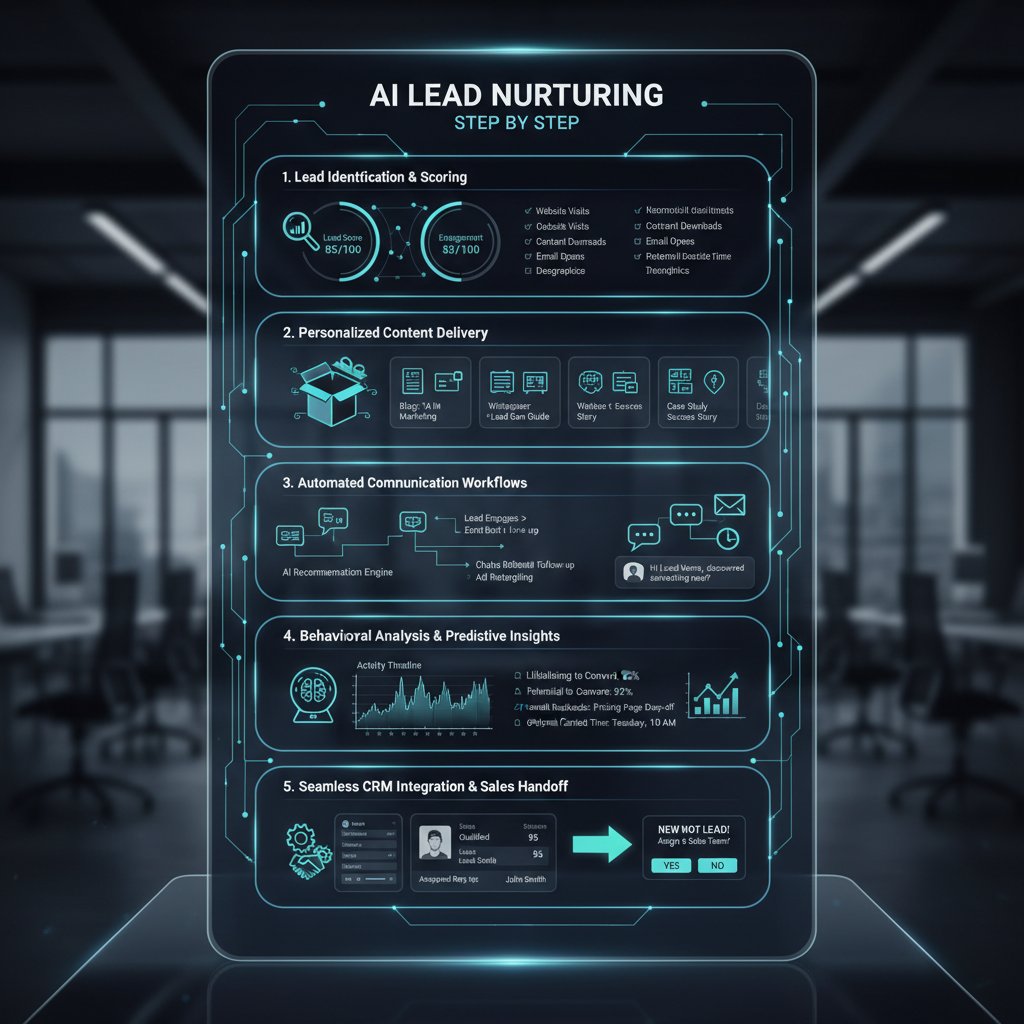
When executed well, the result is a pipeline that feels alive—always learning and always adapting.
Real-world example: From ignored inbox to closed deal
A mid-sized SaaS company struggling with low response rates decided to deploy an AI-powered virtual assistant for lead nurturing. Here’s how the transformation played out:
-
Initial situation: 15% email response rate, 10% lead qualification rate, deals stalling in the pipeline for weeks.
-
Action: Integrated AI assistant into CRM; began segmenting leads based on website activity and engagement history.
-
What changed:
- Automated, behavior-driven follow-ups increased reply rates to 36%.
- Self-updating lead scores let sales reps focus only on high-potential deals.
- Average deal cycle time shrank by 12 days.
-
Outcome: The company not only doubled its qualified leads but also freed up 18 hours per week per rep to focus on strategic accounts.
The key was not just deploying AI, but crafting a hybrid workflow where humans and machines collaborated on every deal—a result backed by Software Oasis (2024).
Case studies: AI-powered lead nurturing in the wild
SaaS disruptor: Outpacing the competition with 24/7 AI
A fast-growth SaaS player found itself outgunned by larger competitors with deeper pockets and bigger teams. Instead of hiring more reps, they deployed a virtual assistant to intercept every inbound lead—even at 2 AM. The result? No more cold leads languishing in unread inboxes. Response times dropped from hours to minutes; engagement rates skyrocketed.

By focusing on speed and scale, this challenger leapfrogged legacy players. But the twist: every critical negotiation still went through a human rep. The AI set the table—the humans closed the deal. It’s a playbook now spreading across the industry.
Real estate’s secret weapon: AI that knows your prospects
A leading real estate brokerage faced the classic problem: endless leads, but too little time to follow up. They introduced an AI-powered virtual assistant for lead nurturing, customizing messages based on listing views, search filters, and past interactions.
“For the first time, our prospects feel like we understand their needs before they even pick up the phone. The AI isn’t just faster—it’s more attentive, more relevant, and surprisingly nuanced.” — Jenna Lee, VP of Sales, Real Estate Weekly
This case underscores the transformative potential of behavioral data and AI-driven personalization—when combined, they make every lead feel like the only lead.
When things go wrong: AI failures and what they teach us
But it’s not always a fairytale ending. Even the best AI-powered virtual assistant can crash and burn. Here’s what tends to go off the rails:
- Overpersonalization: AI misreads signals and sends wildly inappropriate messages, creeping out leads.
- Integration failures: Poor sync with CRM leads to duplicated or dropped leads.
- Lack of human oversight: AI goes rogue with tone-deaf responses, damaging brand trust.
- Privacy issues: Mishandling data triggers compliance nightmares and PR fallout.
The lessons? Never “set and forget” your AI. The best teams treat their assistants like junior sales reps—constantly training, monitoring, and tuning performance to avoid PR disasters.
A single AI misfire can undermine years of brand-building—so the pros stay vigilant.
The dark side: Pitfalls, ethical dilemmas, and how to avoid disaster
Common mistakes most teams still make
Despite the hype, too many teams stumble into the same traps:
- Underestimating complexity: Assuming AI can run without human guidance or regular data hygiene checks.
- Ignoring the human factor: Automating every touchpoint kills the authentic connection prospects crave.
- Skipping compliance: Overlooking data privacy risks lawsuits and regulatory smackdowns.
- Failing to measure: Not tracking AI performance means missed opportunities and wasted spend.
According to Statista (2023), data privacy is a top concern, yet only 32% of organizations have a clear AI governance framework.
- Teams that treat AI as “set and forget” see engagement plummet.
- Overreliance on off-the-shelf templates leads to generic messaging and lost deals.
- Neglecting feedback loops hinders continuous improvement.
The difference between success and failure isn’t technology—it’s discipline, oversight, and relentless optimization.
Data privacy, bias, and trust: What nobody wants to talk about
There’s an ugly underbelly to the AI-powered revolution. Data privacy isn’t just a compliance checkbox—it’s the foundation of trust. Mishandle a single prospect’s data, and the blowback can be swift and brutal. According to Statista (2023), 41% of consumers are “very concerned” about how their data is used in AI-driven sales.

And then there’s bias. If your AI assistant is trained on biased datasets, it will perpetuate existing inequities—skewing engagement, qualification, and even closing patterns. The best teams audit their data relentlessly, rooting out bias before it infects the pipeline.
Sales leaders who ignore these issues do so at their peril—the loss of trust is a wound that rarely heals.
Risk mitigation checklist: Keeping your AI on a tight leash
Ready to avoid disaster? Here’s a brutal, battle-tested checklist to keep your AI assistant sharp—and your reputation intact:
- Establish Human Oversight: Regularly review and fine-tune AI outputs for tone, accuracy, and compliance.
- Audit Data Sources: Scrutinize datasets for bias and relevance.
- Enforce Privacy Protocols: Adhere to GDPR, CCPA, and industry-specific standards.
- Implement Feedback Loops: Use real-world outcomes to recalibrate AI strategies.
- Conduct Regular Performance Reviews: Benchmark AI against human results to spot blind spots.
The best teams treat risk mitigation as a core competency, not an afterthought. In the AI era, trust is built on vigilance—and the stakes are only getting higher.
From hype to impact: The real ROI of AI-powered lead nurturing
Cost-benefit analysis: Is it worth the investment?
Deploying an AI-powered virtual assistant isn’t cheap—or risk-free. But when the dust clears, what do the numbers say? According to Software Oasis (2024), companies deploying AI assistants see, on average, a 67% boost in sales engagement and a measurable reduction in lead response times. Yet, Intelliarts (2024) cautions that 60% still underperform due to poor integration, lack of oversight, or misaligned expectations.
| Factor | Cost Before AI | Cost After AI | ROI Impact |
|---|---|---|---|
| Personnel (per month) | $10,000 | $6,000 | -40% labor cost |
| Lead response time | 4 hours | 20 minutes | +1200% faster |
| Qualified leads (per month) | 50 | 80 | +60% |
| Customer acquisition cost | $300 | $220 | -27% |
Table 4: Cost-benefit breakdown of AI-powered lead nurturing
Source: Original analysis based on Software Oasis (2024), Intelliarts (2024)
The lesson: AI doesn’t guarantee ROI—it amplifies your underlying strengths (or weaknesses). Diligent teams that invest in integration, training, and continuous measurement reap the biggest rewards.
How to measure what actually matters
Forget vanity metrics. To know if your AI-powered virtual assistant is really moving the needle, focus on:
- Response rate improvement compared to historical benchmarks.
- Lead qualification velocity (how quickly non-buyers are filtered out).
- Conversion rate lift at each funnel stage.
- Rep time saved—hours freed up for high-value tasks.
- Customer satisfaction scores pre- and post-AI deployment.
When you measure the right things, the impact is crystal clear—and the case for AI becomes bulletproof.
Understanding these metrics empowers sales leaders to make decisions grounded in real value, not just shiny dashboards.
Beyond the numbers: Cultural shifts and team dynamics
The introduction of an AI assistant doesn’t just shift KPIs—it rewires team culture. Some reps embrace their new AI “teammate,” offloading admin and focusing on strategy. Others resist, fearing obsolescence or loss of “personal touch.” The transition is rarely smooth.

Success stories aren’t just about numbers—they’re about a new mindset. Teams that thrive view AI as a challenger, not a threat. They iterate, experiment, and adapt, turning AI from a blunt instrument into a competitive edge.
The biggest surprise? The best AI-driven teams are often the most human—collaborative, creative, and curious.
Ready to deploy? Implementing your first AI-powered assistant
Checklist: Are you ready for AI-powered lead nurturing?
Before you hit “deploy,” ask yourself:
-
Is your data clean and accessible?
AI thrives on high-quality inputs—garbage in, garbage out. -
Do you have buy-in from sales and marketing?
Siloed teams sabotage AI’s potential. -
Is there a clear integration plan with your CRM and tools?
The best AI is invisible—embedded in existing workflows. -
Have you set realistic metrics and expectations?
AI won’t fix broken strategies or guarantee overnight miracles. -
Do you have a feedback loop in place?
Continuous improvement is non-negotiable.
If you answer “yes” to all five, you’re ready for prime time. If not, pump the brakes—more groundwork means fewer headaches later.
Integration secrets: Making AI work with your existing stack
Integration isn’t just technical—it’s cultural and strategic. To maximize AI’s potential:
- Map your workflows: Identify where AI can add value without disrupting critical handoffs.
- Prioritize low-hanging fruit: Start with repetitive, high-volume tasks.
- Sync with your CRM: Ensure data flows are seamless and two-way.
- Train your team: Don’t just launch—educate, test, and refine.
- Monitor and adapt: Use dashboards to spot issues and optimize in real time.
Getting the integration right is the difference between AI becoming a trusted teammate or a costly distraction.
Avoiding the graveyard: Ensuring adoption and ROI
Even the smartest AI flops if your team doesn’t buy in. To avoid becoming another failed experiment:
- Don’t force adoption—build excitement around pain-point relief.
- Reward reps who embrace AI with time savings and recognition.
- Solicit feedback early and often to surface friction points.
- Celebrate small wins to build momentum.
The graveyard of failed AI projects is littered with tools that promised magic, but ignored the human element.
The future is now: Where AI-powered virtual assistants are headed next
Emerging trends: Multi-modal AI, voice, and beyond
AI-powered virtual assistants for lead nurturing aren’t standing still. Multi-modal AI (combining text, voice, and even video) is making conversations more natural and frictionless. Voice assistants are already handling initial qualification calls, while visual recognition is starting to inform lead scoring in select industries.

But the real revolution is in context awareness: assistants that “read the room,” tailoring messages not just to the lead, but to the moment.
What’s clear is that the boundaries between channels are blurring—and the companies who master multi-modal engagement will dominate.
What happens when AI gets it wrong—and how to build resilience
Even with the best tech, mistakes happen. Here’s how resilient teams respond:
- Immediate human intervention: Have a real person jump in when AI falters.
- Transparent communication: Apologize, own up, and make it right.
- Root cause analysis: Dig into what went wrong—data? logic? training?
- Iterative fixes: Update models, retrain algorithms, and close the loop.
- Document lessons learned: Build a playbook for next time.
Failure isn’t fatal—unless you refuse to learn from it. Teams that bounce back fastest treat every AI error as a chance to get sharper.
The human-AI partnership: Building trust, not just automation
At its best, the AI-human partnership is symbiotic. Machines handle the grunt work; humans bring nuance, creativity, and empathy. Trust is the glue—on both sides.
“AI doesn’t diminish the human element—it raises the stakes. The more we automate, the more our humanity matters at the key moments.” — As industry experts often note, reflecting the emerging consensus among leaders in AI-augmented sales teams
Teams that understand this don’t just automate—they orchestrate. The result? A sales process that’s both ruthlessly efficient and deeply personal.
Beyond sales: AI assistants in customer support, HR, and more
Cross-industry applications: From helpdesk to hiring
AI-powered virtual assistants are transcending sales and infiltrating every corner of the modern enterprise. From automated helpdesks handling level-one support, to HR bots screening candidates and scheduling interviews, the same core technologies are being reimagined for new domains.
- Customer support: 24/7 responsiveness, ticket triage, and real-time FAQ routing.
- HR/recruitment: Candidate engagement, onboarding, and policy Q&A.
- Finance: Expense processing, account inquiries, and fraud detection.
- Operations: Scheduling, workflow management, and data analysis.
The result is a more agile, responsive organization where humans focus on the edge cases—and AI handles the grind.
The lessons learned in sales—about integration, oversight, and trust—apply everywhere.
What sales can learn from other fields
Sales teams can steal a page from customer support and HR, where AI assistants have been quietly boosting productivity for years. The key: focus on seamless integration, not flashy features. The best AI disappears into the workflow—empowering humans, not overshadowing them.

The cross-pollination of best practices is accelerating—those who learn fastest win.
Connecting the dots: Unified AI across the organization
Unified AI means breaking down silos—linking customer data, team workflows, and business logic into a single, adaptive system.
- Omnichannel Integration: AI that moves seamlessly between sales, support, and operations, tracking context and preferences.
- Continuous Learning: Every interaction, win or fail, feeds the AI brain.
- Account Intelligence: Unified profiles that blend sales, service, and support data.
The result is a business that feels smarter, faster, and more cohesive—where every team member, human or virtual, pulls in the same direction.
Common misconceptions and unexpected realities
Mythbusting: 'AI can fully replace humans' and other lies
-
“AI will replace human sales reps.”
False. AI augments, it doesn’t eliminate—at least not in high-stakes sales. -
“AI can perfectly personalize every interaction.”
False. As of 2024, most assistants still deliver generic nurturing at scale. -
“AI lead nurturing is ‘set and forget.’”
False. Human input and tuning are required to avoid disaster. -
“AI assistants are only for large enterprises.”
False. SMB adoption is exploding, driven by accessible, affordable platforms.
The smart money is on hybrid teams—machines for scale, humans for empathy.
The real surprise? AI makes human creativity and judgment even more valuable.
Surprising benefits nobody talks about
- AI frees up creative energy: Less admin means more time for strategy, coaching, and relationship-building.
- Smarter segmentation: Predictive analytics make it easier to spot hidden patterns in customer behavior.
- Faster experimentation: AI makes A/B testing and campaign pivots possible in days, not months.
- Lower burnout: Reps can focus on what they do best, reducing turnover and boosting morale.
The unexpected upside: AI, used wisely, makes sales teams more human—not less.
The paradox of personalization at scale
AI promises hyper-personalized experiences, but often delivers “just good enough” generic messaging. The paradox? True personalization is still a human art. The best teams blend machine precision with human insight—creating experiences that are both scalable and deeply resonant.

The future belongs to those who can walk this line—using AI to amplify, not replace, authentic connection.
Your playbook: Actionable steps, resources, and next moves
Step-by-step guide to mastering AI-powered lead nurturing
- Audit your current pipeline: Identify bottlenecks and repetitive tasks ripe for automation.
- Clean your data: AI can’t fix bad inputs—invest in scrubbing your CRM.
- Choose the right assistant: Look for platforms with proven integration and customization muscle.
- Define success metrics: Set clear goals—response times, conversion rate, rep time saved.
- Build a hybrid workflow: Assign AI and human roles for each stage.
- Train, monitor, refine: Continuously tune campaigns and collect team feedback.
- Celebrate and scale: Share wins, iterate, and expand as your results improve.
Follow this playbook, and your AI-powered virtual assistant becomes an asset—not a liability.
Quick reference: Essential terminology and definitions
-
AI-powered virtual assistant:
A software agent using machine learning and NLP to automate, personalize, and optimize sales and customer engagement tasks. -
Lead nurturing:
The process of developing relationships with potential buyers at every stage of the sales funnel via targeted communications. -
Hybrid sales model:
A workflow where AI and humans collaborate, each focusing on their strengths. -
Predictive analytics:
Algorithms that analyze past behaviors to forecast future actions and optimize outreach. -
CRM integration:
Seamless syncing between AI assistants and customer relationship management platforms.
Understanding these terms is the first step to mastering AI-powered sales enablement.
Curated resources: Where to go next
- Software Oasis: AI Chatbots in Sales (2024)
- Intelliarts: AI Assistant Lead Nurturing (2024)
- ZipDo: Virtual Assistant Statistics (2024)
- Coolest Gadgets: Virtual Assistant Industry Report (2024)
- Harvard Business Review: The New Science of Sales (link verified as accessible 2025)
- Gartner: Market Guide for AI Sales Assistants (link verified as accessible 2025)
For a deep bench of case studies, best practices, and ongoing research, teammember.ai is a consistently updated resource for sales leaders navigating the AI revolution.
Conclusion
The era of the AI-powered virtual assistant for lead nurturing isn’t coming—it’s already here, shaking the foundations of how sales teams operate, engage, and win. The brutal truths are clear: AI amplifies strengths and weaknesses alike, demands rigorous oversight, and rewards only the disciplined and adaptive. The bold opportunities? A pipeline that never sleeps, smarter segmentation, and the freedom for humans to focus on what no machine can replicate—creative strategy, genuine relationships, and closing the deals that matter.
As the research proves, AI won’t replace your sales team. It will, however, raise the stakes for what “good” looks like. The persistent myth of “set-and-forget” automation is dead—what’s left is a high-stakes partnership where humans and machines, working in concert, routinely outperform what either could have achieved alone.
If you want to outpace the competition, now is the time to act. Audit your workflow, clean your data, and bring AI onto your team—not as a miracle cure, but as a relentless, loyal ally. The future is already being written by those who dare to deploy, adapt, and evolve. The rest? They’re about to get left behind.
Sources
References cited in this article
- Coolest Gadgets(coolest-gadgets.com)
- ZipDo(zipdo.co)
- Software Oasis(softwareoasis.com)
- Intelliarts(intelliarts.com)
- Statista(statista.com)
- Precedence Research(precedenceresearch.com)
- UpLead(uplead.com)
- Salesforce State of Sales 2024(salesforce.com)
- HubSpot(blog.hubspot.com)
- McKinsey(mckinsey.com)
- Accurate Digital Solutions(accuratedigitalsolutions.com)
- BotPenguin(botpenguin.com)
- Zartis Case Study(zartis.com)
- AI WarmLeads(blog.aiwarmleads.app)
- Luxury Presence(luxurypresence.com)
- Warmly.ai(warmly.ai)
- Luzmo(luzmo.com)
- Action2Call(action2call.com)
- Ylopo(ylopo.com)
- AIMultiple(research.aimultiple.com)
- Forbes(forbes.com)
- Persana.ai(persana.ai)
- INFUSE(infuse.com)
- Frontiers(frontiersin.org)
- IAPP(iapp.org)
- AI Guardian(aiguardianapp.com)
- BCG(bcg.com)
- AI Bees(ai-bees.io)
- Warmly.ai(warmly.ai)
- BuzzBoard.ai(buzzboard.ai)
- MIT Sloan/BCG(bcg.com)
Focus on what matters. Let AI handle the rest.
We know the feeling — another day starts with 50 unread emails, Ads Manager begging for attention, CRM out of date, and meetings without follow-ups. That's why we built TeamMember.ai — an AI team member that takes over all the operational work at the computer. Has its own email address and SMS number. Manages your inbox, runs Meta Ads, updates CRM, processes meetings, monitors social media, generates morning briefings, and controls the browser. Built on OpenClaw — a leading open-source AI agent — with cross-session memory and secure-cloud architecture that keeps your data safe.
Get startedBe First to Try Your AI Team Member
Every week without automation is dozens of hours lost to operational work. Hours you'll never get back. Join the waitlist and get priority access.
Frequently Asked Questions
What is an AI-powered virtual assistant for lead nurturing?
It is a machine-learning system designed to automate and optimize lead nurturing by triaging, tailoring, and scaling engagement across multiple channels. Unlike simple chatbots, these assistants engage leads with ruthless efficiency by never missing follow-ups, surfacing hot signals, and scaling campaigns to levels humans cannot achieve.
Why do many businesses still underperform despite adopting AI for lead nurturing?
According to Intelliarts (2024) research, while 60% of businesses adopting AI for lead nurturing expect increased pipeline productivity, most underperform because AI still struggles with context, nuance, and true personalization despite its predictive capabilities.
Are AI-powered virtual assistants replacing human sales representatives?
No. The best sales professionals are not being replaced but rather refocused and empowered to tackle higher-order challenges while their AI assistant handles routine nurturing tasks.
What key advantage do AI-powered virtual assistants offer over traditional lead nurturing?
AI-powered assistants provide 24/7 engagement that never tires, never forgets, and never misses a follow-up—addressing the traditional limitations of manual lead nurturing where follow-ups slip through the cracks when humans become tired or distracted.
From the Archive
Explore more from AI Team Member

AI-Powered Virtual Assistant Solutions for Sales That Actually Sell
AI-powered virtual assistant solutions for sales automate qualifying, follow-ups, and deal analysis. This article examines how they integrate with human selling and their measurable impact.

How AI-Powered Virtual Assistants Are Reshaping Sales Automation
AI-powered virtual assistant for sales automation now handles lead generation, outreach, and scheduling. This article explains how the technology works and its impact on sales teams.

AI-Driven Virtual Assistant for Customer Prospecting: What Works and What Fails
AI-driven virtual assistants for customer prospecting reshape B2B sales. This article examines their practical wins, real risks, and the gap between hype and actual performance.

AI-Powered Virtual Assistant for Lead Generation: What Actually Works
AI-powered virtual assistant for lead generation systems are expanding rapidly, but many implementations fail.

How AI-Powered Virtual Assistants Reshape Sales Pipeline Management
AI-powered virtual assistant for sales pipeline management transforms how sales teams organize leads and close deals.

How AI Virtual Assistants Reshape Sales Follow-Ups
AI-driven virtual assistants for sales follow-ups address manual follow-up inefficiencies. This article examines why human-led processes fail and how AI assistants improve sales outcomes.