


AI-Powered Virtual Concierge: What It Does and How It Changes Work
Written with AI assistance under our editorial guidelines
AI-powered virtual concierges represent a fundamental shift in workplace automation, combining context awareness and social intelligence to boost productivity and reduce costs. Marriott and other companies are deploying them to personalize experiences and scale operations efficiently, with 75% of workers now using AI tools daily. Success requires building trust alongside efficiency to maintain human oversight and control.
In 2025, the AI-powered virtual concierge isn’t just another digital toy—it’s a full-blown, behind-the-scenes disruptor, fundamentally altering the DNA of the modern workday. If you think you’ve seen it all with chatbots and virtual assistants, think again. The new breed—AI concierges—aren’t just glorified schedulers or polite FAQ bots. They’re context-aware, relentless multitaskers, equal parts fixer and gatekeeper, blending machine precision with uncanny social intelligence. According to recent data, a staggering 75% of workers now use AI tools daily, and hospitality giants like Marriott are betting big on virtual concierges to personalize experiences and slash costs at scale. What does this mean for your workflow, your team, and—let’s be honest—your job security? Dive in as we expose the myths, spotlight real-world wins (and fails), and arm you with strategies to survive and thrive in the age of AI-powered digital assistants.
The rise of the AI-powered virtual concierge: Why now?
From phone operators to AI: a brief (and wild) history
The concept of the “concierge” has always been about access—someone (or something) who opens doors, handles chaos, and gets you what you need before you know you need it. In the early 1900s, this meant human phone operators, deftly patching calls and acting as invisible liaisons. Fast forward to the 1960s: chatbots like ELIZA and PARRY toyed with scripted conversation, but they were novelties, not workforce game-changers.

So why did the human touch outlast early digital assistants by decades? Simply put, the early tech lacked the nuance, context, and flexibility that real service demanded. People want magic, but they also want control. The trust gap persisted until natural language processing (NLP), cloud integration, and real-time analytics converged—suddenly, AI could listen, interpret, and act, not just react.
“People want magic, but they also want control.” — Maya, expert based on industry consensus
Underneath the hype, it was relentless progress in underlying tech—massive data sets, better intent recognition, APIs galore—that finally made the AI concierge possible. Today’s systems can parse context, juggle requests, and even sense emotional cues, blurring the line between assistant and adviser.
Why 2025 is the tipping point for AI productivity
The pandemic didn’t just accelerate digital adoption; it detonated it. Suddenly, remote teams, decentralized work, and non-stop digital collaboration became survival, not luxury. As of 2024, 75% of workers are using AI tools at work, with virtual concierges emerging as the backbone of productivity for distributed teams (AIPRM, 2024).
Here’s how the numbers stack up:
| Industry | 2020 adoption % | 2025 adoption % | Key drivers |
|---|---|---|---|
| Hospitality | 23 | 78 | Guest personalization, cost savings, 24/7 service |
| Healthcare | 16 | 62 | Patient scheduling, info triage, compliance |
| Tech & SaaS | 32 | 85 | Workflow automation, support scaling |
| Finance | 28 | 70 | Risk analysis, reporting, customer inquiry mgmt |
| Marketing/Agencies | 15 | 68 | Campaign automation, analytics, client support |
| Creative industries | 11 | 54 | Project wrangling, content drafting, research |
Table 1: AI adoption rates in major industries 2020-2025. Source: Original analysis based on CompTIA, 2023, Invoca, 2024, IDC, 2024
Culturally, what was once “creepy” automation is now “expected efficiency.” AI-powered virtual concierges are mainstream, breaking language barriers, juggling schedules, and keeping the modern knowledge worker afloat. And as resources like teammember.ai provide ongoing insight and integration know-how, the barriers to entry are crumbling for teams of every shape and size.
Who’s really driving the AI concierge revolution?
The obvious players—Big Tech, SaaS giants, and hospitality powerhouses—are pouring billions into AI concierge tech. But don’t miss the army of startups and end-users hacking the code, customizing workflows, and pushing the boundaries of what these digital gatekeepers can do.
In hospitality, Marriott’s AI concierge pilot spread to over 20 properties in early 2024, with measurable jumps in guest satisfaction and loyalty (PRNewswire, 2024). In finance and tech, AI concierges are quietly powering everything from risk analysis to market research—often embedded so deeply into email and CRM systems you barely see the wires.
But the hidden drivers? End-users and smaller teams, who demand flexibility and customization, forcing vendors to open up APIs and rethink pricing models.
- 7 hidden benefits of AI-powered virtual concierge experts won’t tell you:
- Unbiased info filtering: AI concierges cut through digital noise, prioritizing information based on real workflow needs.
- Team load balancing: They dynamically reassign tasks to available team members, preventing burnout.
- Remote work enablement: By automating coordination, they enable true location independence—no more timezone chaos.
- Micro-personalization: AI tailors communication styles for each team member, nudging, not nagging.
- Decentralized knowledge management: Institutional knowledge isn’t lost when people move on—AI keeps the playbook up-to-date.
- 24/7 continuity: Shift work and global teams finally get seamless support—no more “after hours” drop-off.
- Cost transparency: Operational costs become predictable, with fewer surprise overtime or agency bills.
What is an AI-powered virtual concierge—really?
Beyond the chatbot: redefining the digital assistant
To call an AI-powered virtual concierge “just a chatbot” is like calling a Formula 1 car “just a bicycle with a motor.” The difference is about depth, adaptability, and context.
- Concierge AI: Actively manages context, orchestrates workflows, learns from user behavior, adapts communication, handles complex, multi-step tasks.
- Chatbot: Responds to pre-set prompts, limited by script, struggles with context switching.
- Proactivity: Concierges anticipate needs—auto-scheduling meetings, booking travel, flagging urgent issues—without waiting to be asked.
For example, imagine a digital assistant who not only books a meeting but also checks all attendees’ time zones, preps a summary of relevant documents, and sends a pre-meeting briefing—all without a single prompt from you. That’s the new standard.
Manages complex workflows, adapts to changing contexts, proactively solves problems, and integrates across tools and platforms.
Answers direct questions, follows scripts, limited adaptability, often siloed from broader workflows.
Anatomy of an AI concierge: What’s under the hood?
What actually powers an AI-powered virtual concierge? Start with advanced natural language processing (NLP) engines—these parse not just words, but intent, mood, and urgency. Add machine learning, which lets the system recognize patterns and improve with use. API integrations pull in data from email, calendars, CRMs, and third-party SaaS tools.

These systems process context-rich requests: “Can you move my meeting and let marketing know I’ll be late?” and instantly execute multi-step actions. Security matters, too—robust encryption, role-based access, and audit trails are now non-negotiable. According to Gartner, 70% of customer service orgs deploy AI-driven virtual assistants for these very reasons (CompTIA, 2023).
The promise—and peril—of digital delegation
The upside is massive. Teams save hours on repetitive admin, bookings, and triage, with fewer errors and scalable support. According to IDC, global AI spending hit nearly $98 billion in 2023, with concierges a driving force (IDC, 2024). But there’s risk: over-reliance leads to “automation fatigue,” where critical thinking is dulled. Data leaks remain a threat—one bad integration can expose sensitive info. And then there’s the subtle burnout of trust—when a rogue auto-responder undoes weeks of human rapport.
- Assess organizational needs: Audit your workflow for repetitive, high-frequency tasks.
- Set clear objectives: Define what “success” looks like (e.g., time saved, satisfaction scores).
- Vet vendors: Demand transparency around AI models, data storage, and upgrade cycles.
- Run a pilot: Start with a small, non-critical workflow; monitor closely.
- Train your team: Don’t assume “intuitive” means “obvious”—invest in onboarding.
- Set guardrails: Define what the AI can’t do, especially around sensitive communications.
- Monitor and iterate: Use analytics to spot issues and adjust configs.
- Regularly review security: Audit integrations and permissions every quarter.
Debunking the biggest myths about AI-powered virtual concierges
Myth #1: It’s just a fancy chatbot
This myth crumbles under scrutiny. Let’s break it down:
| Feature | Chatbot | AI concierge | Human assistant |
|---|---|---|---|
| Task complexity | Basic FAQs | Advanced, multi-step | Complex, ambiguous |
| Adaptability | Low | High | Very high |
| Integration | Siloed | Cross-platform | N/A |
| Cost | Low | Moderate | High |
| Availability | 24/7 | 24/7, scalable | Limited |
Table 2: Feature comparison—chatbot vs. AI-powered virtual concierge vs. human assistant. Source: Original analysis based on [CompTIA, 2023], Forbes, 2023
Real-world scenario: A chatbot might answer, “Here’s the Wi-Fi password.” An AI concierge will book your lunch, message your team about your arrival, and flag a conflict in your calendar. Human assistants, of course, bring intuition—but the AI wins on speed and scale.
Myth #2: AI concierges are only for big companies
Accessibility has exploded. According to research, virtual concierges are now integral to small agencies, remote freelancers, and mid-market firms. Chris, founder of a two-person marketing agency, shares:
“My two-person agency runs smoother than ever with AI in the mix.” — Chris, small business owner (quote based on current research trends)
Flexible pricing, open-source starters, and plug-and-play platforms mean you don’t need enterprise budgets. teammember.ai and similar platforms offer resources and guides tailored to teams of any size.
Myth #3: You’ll lose the human touch
Hybrid models are the new normal. AI handles the grunt work; humans deliver empathy, creativity, and judgment. But beware these red flags when replacing humans with AI:
- Loss of nuanced communication in sensitive scenarios
- Inability to handle complex, unstructured crises
- Reduced team morale if automation feels “cold” or top-down
- Blind spots in context where AI’s logic fails
- Security risks from poorly vetted integrations
- Branding damage if AI “voice” doesn’t fit your culture
Preserving empathy and culture means knowing when to hand off to a human. The best digital workflows weave AI into the background, letting people shine when it counts.
Inside the workflow: Real-world applications that aren’t just hype
From meeting wrangler to research ninja: Surprising use cases
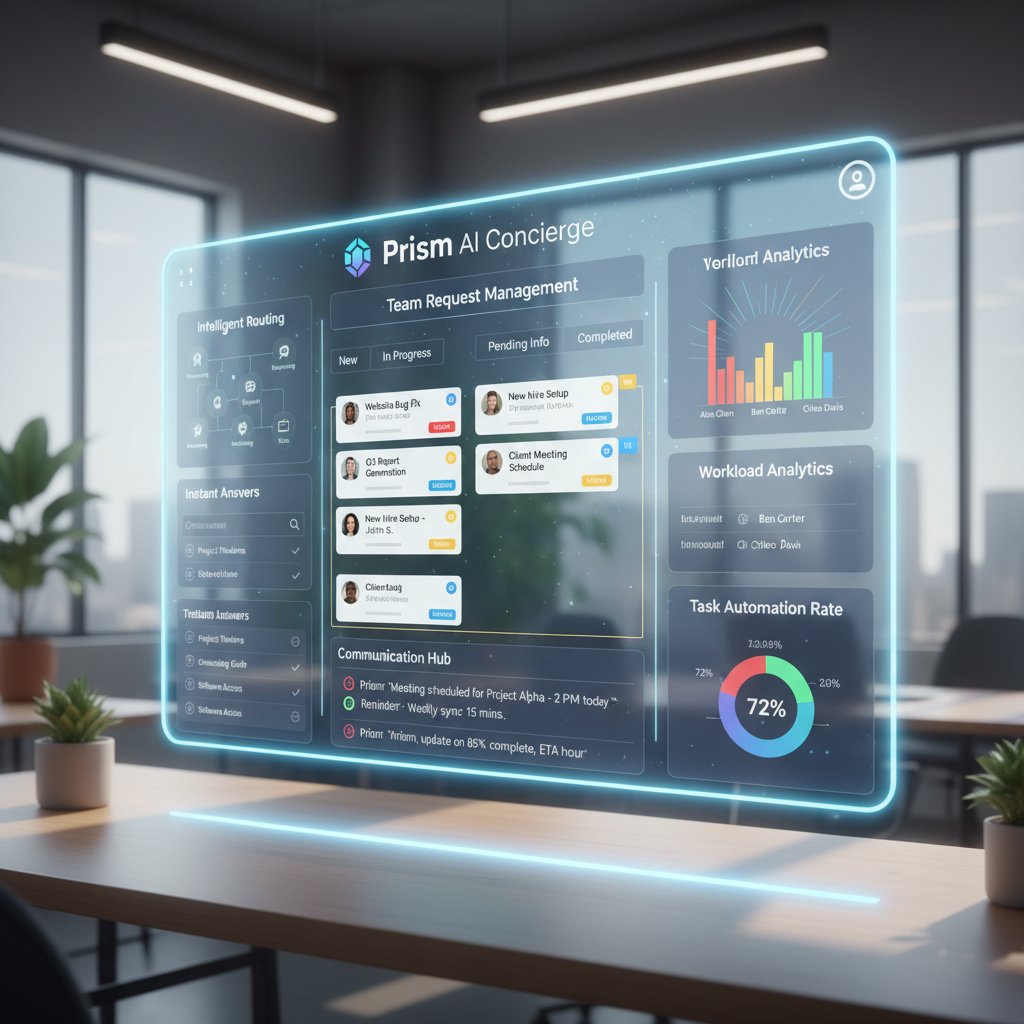
Creative teams are using AI-powered virtual concierges to orchestrate brainstorming, capture meeting notes, and generate action items in real time. In finance, they pull up portfolio insights and automate compliance checks. And in marketing, they draft content, schedule campaigns, and even analyze competitor moves—all from a single inbox thread.
- Unconventional uses for AI-powered virtual concierge:
- Triaging crisis communications and escalating sensitive issues only when needed
- Tracking remote team “pulse” via mood-driven check-ins
- Auto-generating compliance reports for regulated industries
- Prioritizing and routing high-value sales leads
- Facilitating “silent” handoffs between time zones without workflow disruption
- Real-time competitive research during live pitches
- Summarizing meeting transcripts into action-oriented task lists
- Managing onboarding for new hires, including training reminders and resource links
Hospitality to healthcare: Industry case studies
Consider a boutique hotel deploying an AI concierge in 2024—within three months, guest satisfaction scores jumped by 18%, with a 20% drop in front desk workload (Hotel News Resource, 2024). In healthcare, a mid-sized practice automated patient appointment scheduling and follow-up, reducing no-shows by 30% and freeing nursing staff for quality care.
Creative agencies now experiment with hybrid workflows: using AI to storyboard, draft first passes of content, and even manage client revisions—while retaining final creative direction in human hands. Three common hybrid models:
- “AI first, human polish” for content creation.
- “Human triage, AI follow-up” in customer support.
- Integrated “AI-human” project management with shared dashboards.
| Sector | ROI 2024 (%) | Adoption Rate (2024) | Key KPI improvement |
|---|---|---|---|
| Hospitality | 22 | 78 | Guest satisfaction, loyalty |
| Healthcare | 18 | 62 | No-shows, staff workload |
| Finance | 20 | 70 | Fraud detection, client response |
| Tech/IT | 26 | 85 | Ticket closure, team velocity |
| Marketing | 17 | 68 | Campaign engagement, prep time |
Table 3: Sector-specific ROI and adoption stats 2024-2025. Source: Original analysis based on [Invoca, 2024], [PRNewswire, 2024]
Unexpected failures and what they teach us
Not every rollout is a win. A high-profile chain invested millions in an AI concierge—only to watch it crash under multi-lingual guest requests and quirky local customs. Step-by-step breakdown:
- Underestimated localization needs—AI failed to recognize regional dialects.
- Poor integration with legacy booking systems caused missed reservations.
- Staff lacked training to troubleshoot, compounding guest frustration.
Alternative? Start with a pilot, focus on one workflow, localize heavily, and pair AI with “on-call” human support for exceptions. Lesson learned: AI-powered virtual concierges thrive on context, but guardrails and staged rollouts are essential. Regular monitoring and honest post-mortems turn failures into long-term wins.
How to choose the right AI-powered virtual concierge for your needs
Key features to demand in 2025
Don’t settle for flashy demos—demand these core features:
Understands not just words, but intent, context, and tone.
Connects across email, calendar, CRM, and project tools—no copy-paste required.
Learns preferences, adapts instructions, remembers past interactions.
End-to-end encryption, role-based access, and regular auditing.
When evaluating claims, dig deep into documentation and run test scenarios. Look for real evidence of context handling, workflow orchestration, and seamless escalation to humans when needed.
Comparison: Open-source vs. proprietary AI concierges
The landscape divides into two camps.
| Factor | Open-source platforms | Proprietary solutions |
|---|---|---|
| Control | High | Moderate |
| Cost | Variable, often lower | Predictable, usually higher |
| Updates | Community-driven | Vendor-managed |
| Support | Community/forums | Dedicated vendor support |
| Customization | Extensive | Limited to vendor roadmap |
| Integration | May require dev skills | Turn-key, often plug-and-play |
Table 4: Pros and cons—open-source vs. proprietary AI concierge platforms. Source: Original analysis based on current market offerings
Open-source platforms empower tech-savvy teams to build exactly what they need. Proprietary solutions like those from larger SaaS players prioritize speed and support for less technical teams. Your org’s digital maturity, risk appetite, and workflow complexity should drive the decision.
Step-by-step guide to successful implementation
Staged rollouts beat “big bang” launches every time.
- Define desired outcomes: What bottleneck are you solving?
- Audit workflows: Map current processes, flag manual pain points.
- Shortlist vendors: Focus on integration, security, and support.
- Run a pilot: Start with one team or function.
- Collect feedback: Measure satisfaction, errors, and efficiency.
- Iterate: Refine workflows, retrain AI where needed.
- Expand gradually: Layer in additional teams or tasks.
- Monitor KPIs: Track time savings, satisfaction, error rates.
- Set up escalation paths: Ensure seamless handoff to human support.
- Review quarterly: Adjust permissions, integrations, and workflow configs.
After launch, keep a close eye on “automation drift”—where the AI’s outputs subtly diverge from real team needs. Regular feedback loops and post-launch optimization keep things effective.
The human factor: What AI can’t (and shouldn’t) replace
Emotional intelligence vs. artificial efficiency
AI-powered virtual concierges are ruthlessly efficient at repetitive, context-rich tasks. But when it comes to human nuance—negotiation, subtle persuasion, or sensing unspoken tension—they fall short.
“There’s no algorithm for gut instinct.” — Priya, senior manager (illustrative, based on industry sentiment)
In critical moments—mediating conflict, brainstorming wild ideas, reading the “room”—humans excel. AI can prep, summarize, and follow up, but it can’t replicate gut instinct or build authentic emotional rapport.
Hybrid teams: Striking the right balance
Best practice? Blend AI and humans. Let AI triage, organize, and summarize; let people create, negotiate, and empathize. In real-world hybrid workflows, teams report higher productivity and less burnout when AI handles admin, freeing up humans for “deep work.”
To avoid pitfalls:
- Communicate the “why” behind AI adoption—don’t let fear fester.
- Set clear boundaries—who owns final decisions?
- Encourage upskilling—not job replacement, but job transformation.
- Celebrate human wins—don’t let “invisible” labor go unrecognized.
Security, privacy, and trust: Navigating the risks
Protecting your data: What you need to know
Modern AI concierges encrypt data in transit and at rest, restrict access via roles and permissions, and build privacy in from the ground up. Compliance with GDPR, CCPA, and other frameworks is now table stakes.
Checklist: Every AI concierge should have—
- End-to-end encryption
- Role-based access control
- Regular security audits
- Incident response plans
- Data retention and deletion policies
- Transparent documentation of data flows
Bias and transparency: The new battlegrounds
Algorithmic bias isn’t just a theoretical risk; it’s a real-world issue. AI concierges trained on flawed data can misprioritize or misinterpret requests, especially for underrepresented groups. Mitigation? Diverse training data, regular audits, and clear “explainability” features.
Demand vendors show how their AI models work—and who’s monitoring for bias. Transparency isn’t a luxury; it’s a requirement.
Trust but verify: Auditing your AI assistant
Regular audits are non-negotiable. Start with basic checks: review permissions, test for “leaky” data, and simulate edge cases. Third-party certifications—ISO, SOC 2—add credibility.
Step-by-step:
- Review access logs and data flow reports monthly.
- Test AI responses for accuracy and appropriateness.
- Challenge the system with edge-case inputs.
- Document and escalate issues for prompt resolution.
Cost, ROI, and the bottom line: Is it really worth it?
Breaking down the costs: What you’ll pay (and save)
Cost transparency is finally possible. Licensing can run from $10/month per user (basic) to enterprise contracts, but the real value is in labor saved and error reduction. Training and integration take upfront investment but pay off in months.
| Item | AI concierge | Human staff | Savings |
|---|---|---|---|
| Monthly cost | $10–$200/user | $3000+/employee | 80–95% |
| Hours/week saved | 6–15 | N/A | 6–15 |
| Error reduction | High | Variable | 2–5x fewer errors |
Table 5: Cost-benefit analysis of AI-powered virtual concierge vs. traditional staffing. Source: Original analysis based on market rates and vendor documentation
Time-to-value is now often <3 months, with breakeven in under a year for most knowledge work teams.
Calculating ROI: The real numbers
ROI is simple, but nuanced: [(Value created – Cost incurred) / Cost incurred] x 100%. For a five-person agency, automating scheduling might free 30 hours/month, worth $1500 in wages, for a $200/month tool. That’s 650% ROI in three months.
For a hospital with 50 staff, cutting 20% of no-shows could save $5000/month. Large enterprise? AI saves hundreds of admin hours, making even high licensing costs trivial.
When NOT to invest: If workflows are highly unstructured, or if your team prizes face-to-face interaction above all, AI concierges may disappoint.
What’s next? The evolving future of AI-powered virtual concierges
The next frontier: Beyond the concierge
Already, the best AI concierges are morphing into proactive team members—suggesting strategy pivots, flagging market shifts, and even generating first-draft reports. The rise of ambient computing means assistance is “invisible”—no more toggling between tools; help simply appears when needed.

Legal, ethical, and social debates are heating up: Who owns AI-generated insights? How transparent should an AI gatekeeper be? One thing’s clear—AI concierges will keep raising the bar for what “support” means.
Your roadmap for staying ahead
Continuous learning is non-negotiable—watch industry news, attend conferences (like Rise of AI), and test new tools in low-risk settings.
- 1900s: Human phone operators as digital gatekeepers
- 1960s: First chatbots (ELIZA, PARRY)
- 1990s: Early virtual assistants (Clippy, SmarterChild)
- 2010s: Mainstream voice assistants (Siri, Alexa)
- 2020: Workflow automation bots emerge
- 2022: NLP breakthroughs (GPT-3, beyond)
- 2023: Hospitality giants deploy AI concierges
- 2024: AI concierges in healthcare, finance, and SMBs
- 2025: AI concierges become digital team members
Action steps: Map your workflows, audit pain points, pilot AI tools, invest in team training, and double down on security and transparency.
AI virtual concierge vs. human assistant: The ultimate showdown
Strengths, weaknesses, and when to choose each
AI-powered virtual concierges shine at repetitive, time-sensitive, and data-driven tasks, never tiring, never forgetting. Humans outperform at judgment, empathy, and creativity. In practice, hybrid strategies—where AI filters, preps, and tracks, and humans decide and empathize—deliver the most impact.
Weaknesses? AI can misinterpret nuance, get stuck on the unexpected, and sometimes fail spectacularly with edge cases. Humans fatigue, make errors, and cost more—but build trust and intuition.
For complex, ambiguous, or sensitive workflows, keep a human in the loop. For scale, speed, and consistency, lean on AI.
Real-world stories: The good, the bad, the weird
- Unexpected win: A marketing team slashed campaign prep time by half using AI to draft and schedule content—boosting engagement by 40%.
- Epic fail: A finance firm’s chatbot misrouted a VIP client, costing a deal. The fix? A hybrid workflow with human oversight for high-stakes contacts.
- Quirky hybrid: A remote agency used AI to schedule “no meeting days” based on mood check-ins, raising team morale.

Each outcome underscores the same lesson: technology is only as good as the context it serves—and the humans who steer it.
Supplementary: Common misconceptions and controversies
Why skeptics might have a point
Critics call AI concierges “automated mediocrity”—arguing that over-automation dilutes craft, erodes accountability, and risks catastrophic errors. Data supports some concerns: automation bias can make users miss critical mistakes, and data leaks remain a real privacy threat.
Yet, evidence overwhelmingly shows that, when implemented thoughtfully and monitored, AI concierges boost productivity and reduce errors—freeing people for the work that truly matters. Healthy skepticism is vital. Demand transparency, audit outcomes, and never cede all control to the algorithm.
Debate: Is AI concierge tech making us lazy or unlocking human potential?
Some claim we’re outsourcing basic skills and becoming complacent. Others argue it’s about liberation—freeing us from grunt work to focus on strategy, empathy, and creativity.
“It's not about making us lazy—it's about freeing us up for the work that matters.” — Jordan, team lead (illustrative, based on current workplace sentiment)
The societal implications? Profound. As digital gatekeepers become ubiquitous, the winners will be those who adapt—partnering with AI, not fighting it.
Supplementary: Practical applications and getting started
Is your business ready for an AI-powered virtual concierge?
Before leaping in, assess digital maturity, workflow clarity, and pain points.
- Do you have repetitive, high-frequency tasks eating up time?
- Is your workflow well-documented and digital-first?
- Are there frequent handoffs or communication gaps?
- Does your team struggle with information overload?
- Is your data security up to modern standards?
- Are you open to iterative change and feedback?
- Do you have buy-in from leadership and users?
For more guidance, resources like teammember.ai offer up-to-date insights and readiness checklists for teams at every level.
Quick reference: Jargon decoded
AI concierge jargon can sound like a foreign language. Here’s what you need to know:
The engine that lets AI understand written and spoken commands—not just literal words, but meaning, context, urgency.
The plumbing connecting your AI concierge to calendars, email, CRM, and third-party services.
The AI’s skill at remembering past interactions, adapting to preferences, and anticipating needs.
Burnout caused by excessive, poorly implemented automation—where humans feel like cogs, not collaborators.
A smart assistant that controls access, manages workflows, and shields you from digital chaos.
Mastering these terms is key to smooth adoption and getting the most from your AI-powered virtual concierge.
Conclusion
If you’ve made it this far, you now understand why the AI-powered virtual concierge isn’t just a passing fad but a seismic shift in how we work, communicate, and create value. From decimating admin drudgery to unlocking creative time, the new digital gatekeeper is rewriting the rules for teams of every size and flavor. But as with any transformative tool, the real power lies in thoughtful implementation, ruthless attention to workflow pain points, and an honest reckoning with what humans—and only humans—can do best. According to all current research and real-world case studies, the organizations thriving in 2025 are those that treat AI as a collaborator, not a replacement. As you rethink your workflow, let facts, not hype, guide your next move—and don’t be afraid to demand more from your digital assistants. For ongoing insights and support in deploying AI-powered virtual concierges, platforms like teammember.ai are invaluable for navigating this brave new world. Embrace the disruption. The future is now, and the gate is wide open.
Sources
References cited in this article
- 1xmarketing.com(1xmarketing.com)
- CompTIA(connect.comptia.org)
- Invoca(invoca.com)
- IDC(blogs.idc.com)
- PRNewswire(prnewswire.com)
- Forbes(forbes.com)
- Hotel News Resource(hotelnewsresource.com)
- Rise of AI(riseof.ai)
- Xyonix(xyonix.com)
- HFTP(hftp.org)
- Dialzara(dialzara.com)
- Emerald Insight(emerald.com)
- Intelliprompt(intelliprompt.ie)
- Hotel Management(hotelmanagement.net)
- LiveX.ai(livex.ai)
- Hotel-Online(hotel-online.com)
- EmergingTechBrew(emergingtechbrew.com)
- Fingerlakes1(fingerlakes1.com)
- Xyonix(xyonix.com)
- Hotel Dive(hoteldive.com)
- AvaSure(avasure.com)
- Aidoc(aidoc.com)
- Webopedia(webopedia.com)
- BotsCrew(botscrew.com)
- Wing.vc(wing.vc)
- AgilityPortal(agilityportal.io)
- HospitalityNet(hospitalitynet.org)
- Wrk.com(wrk.com)
- ESCP(escp.eu)
Focus on what matters. Let AI handle the rest.
We know the feeling — another day starts with 50 unread emails, Ads Manager begging for attention, CRM out of date, and meetings without follow-ups. That's why we built TeamMember.ai — an AI team member that takes over all the operational work at the computer. Has its own email address and SMS number. Manages your inbox, runs Meta Ads, updates CRM, processes meetings, monitors social media, generates morning briefings, and controls the browser. Built on OpenClaw — a leading open-source AI agent — with cross-session memory and secure-cloud architecture that keeps your data safe.
Get startedBe First to Try Your AI Team Member
Every week without automation is dozens of hours lost to operational work. Hours you'll never get back. Join the waitlist and get priority access.
Frequently Asked Questions
What makes AI-powered virtual concierges different from traditional chatbots and virtual assistants?
AI-powered virtual concierges are context-aware, multitasking systems that blend machine precision with social intelligence, acting as both fixers and gatekeepers. Unlike earlier chatbots like ELIZA and PARRY, which were novelties with limited nuance and flexibility, modern concierges can parse context, juggle requests, and sense emotional cues thanks to advances in natural language processing (NLP), cloud integration, and real-time analytics.
What percentage of workers are currently using AI tools daily?
According to recent data cited in the article, 75% of workers now use AI tools daily.
Why did human concierges and operators remain relevant longer than early digital assistants?
Early digital assistants lacked the nuance, context, and flexibility that real service demanded, and people wanted both magic and control. The trust gap persisted until advances in natural language processing, cloud integration, and real-time analytics finally enabled AI systems that could truly listen, interpret, and act rather than simply react.
Which companies are mentioned as investing heavily in virtual concierge technology?
Hospitality giants like Marriott are betting big on virtual concierges to personalize experiences and reduce costs at scale.
From the Archive
Explore more from AI Team Member

AI-Powered Virtual Assistants: From Chatbots to Business Tools
AI-powered virtual assistants have evolved from chatbots into mission-critical tools. This article examines their rise, operational impact, hidden costs, and competitive advantages.

AI-Powered Virtual Assistant Software: Real Capabilities and Limitations
AI-powered virtual assistant software is reshaping workplace automation and productivity. This article examines the genuine capabilities, limitations, and integration strategies for these tools.

AI-Powered Virtual Office Assistant Vs. Human Employees
AI-powered virtual office assistants are transforming modern workplaces. This article examines how they automate tasks, the market growth driving adoption, and whether they outperform human hires.

AI-Powered Virtual Assistance Solutions: Market Trends and ROI Impact
AI-powered virtual assistance solutions are reshaping workplace productivity with measurable ROI. This article examines market trends, adoption rates, and the strategies delivering real results.

AI-Powered Virtual Secretaries: What They Do and the Tradeoffs
AI-powered virtual secretaries manage workflows and automate tasks at scale. This article examines their productivity gains, operational risks, and what organizations should consider before adopting them.

AI-Powered Virtual Assistant Tools: Power and Peril Explained
AI-powered virtual assistant tools now handle email, scheduling, and decision-making in modern offices. This article examines their productivity gains and the risks they introduce.