


AI-Driven Data Entry Automation: Wins, Risks, Reality in Organizations
Written with AI assistance under our editorial guidelines
By 2026, AI-driven data entry automation will disrupt legacy workflows and displace millions of jobs while delivering significant accuracy gains and productivity improvements. The technology addresses manual data entry's hidden costs—errors, wasted hours, and cascading mistakes—but implementation remains messy and transformative rather than frictionless, requiring organizations to navigate both substantial benefits and workforce displacement challenges.
If you think AI-driven data entry automation is a gentle revolution, you’re in for a jolt. Far from a frictionless fix, automated data entry is tearing through legacy workflows, exposing inefficiencies, and—let’s not sugarcoat it—putting millions of desk jobs on the line. But behind the corporate gloss and vendor hype lies a messy, transformative truth: automation is neither a magic bullet nor a dystopian hammer. It’s disruptive, often misunderstood, and hiding more upside (and downside) than you’ve been told. In 2025, AI-driven data entry automation isn’t just about eliminating busywork; it’s about redefining how organizations make decisions, control risk, and compete in a world addicted to speed and accuracy. This isn’t a story of robots quietly replacing humans. It’s about power, precision, pain, and the real hidden wins that only surface after you’ve survived the learning curve. Buckle up as we rip the bandage off the hard truths, expose the overlooked victories, and arm you with the insight you actually need to navigate the automation frontier.
Why AI-driven data entry automation matters (and why you should care)
The high cost of manual data entry
Manual data entry is the productivity drain you didn’t know was bleeding your bottom line. Each keystroke is another micro-loss: wasted hours, stifled innovation, and a mounting avalanche of hidden costs. According to the World Economic Forum and Exploding Topics (2024), over 7.5 million data entry jobs are at risk of automation-driven displacement by 2027. That’s not a stat—it’s a warning shot. The impact of clinging to outdated processes isn’t just financial; it’s cultural, driving burnout and frustration across teams forced to wrestle with paper, spreadsheets, and endless double-checking.

Errors are the shadow currency of manual data entry. A single mistyped digit can ricochet through financial reports, inventory systems, and compliance filings, creating a chain reaction of mistakes that’s expensive to untangle. According to UiPath/Statista (2024), error rates in manual data entry are a primary driver for digital transformation, with 85% of respondents agreeing that AI delivers significant gains in accuracy and productivity. The real killer? The insidious “invisible” cost—time spent fixing mistakes, managing exceptions, and firefighting downstream disasters.
"You don’t realize how much you’re losing until you see the numbers." — Alex
The promise and hype of AI-driven automation
AI-driven automation has been sold as a clean break from tedium—press a button, and your data problems vanish. Marketers paint a world where cognitive bots extract, validate, and organize data at a speed that would shame caffeine-fueled interns. But here’s the reality: the gulf between promise and practice is wide, and not every organization crosses it without scars. Vendors rarely tell you about the integration headaches, the upfront costs, or the cultural resistance you’ll face when you ask people to trust an algorithm with mission-critical information.
Let’s cut through the noise: the promise is real, but so are the landmines. According to Workato (2024), data operations accounted for 32.6% of all automation growth in 2023, and generative AI-powered processes leaped by 400%. The upside is massive, but it’s not evenly distributed. While some businesses see skyrocketing ROI and freed-up talent, others get caught in cycles of failed pilots, security scares, and underwhelming returns.
7 hidden benefits of AI-driven data entry automation experts won't tell you:
- Dramatic error reduction—fewer costly mistakes and less reputation risk.
- Freeing up your best people for strategic work rather than mindless data checks.
- Real-time data availability, empowering faster and more confident decisions.
- Enhanced regulatory compliance through automated audit trails.
- Boosted employee satisfaction (once the initial fear fades).
- Agile scaling—handle sudden data surges without frantic hiring.
- Embedded analytics: insights surface automatically as data is processed.
But for every success story, there’s a raft of grim lessons. It’s time to expose the brutal truths that rarely make the sales deck—and arm yourself with the real playbook for 2025.
What actually is AI-driven data entry automation?
Breaking down the technology: From OCR to machine learning
Under the hood, AI-driven data entry automation is less about tech magic and more about clever layering of old and new tools. Optical Character Recognition (OCR) cracks the code on messy paper forms and scanned PDFs. Natural Language Processing (NLP) makes sense of ambiguous, unstructured text. Machine Learning (ML) adapts to patterns, learns from corrections, and gets better (or worse) over time. It’s a Frankenstein’s monster of APIs, algorithms, and feedback loops—all orchestrated to transform raw inputs into clean, actionable data.
Definition list:
- OCR (Optical Character Recognition): Software that “reads” printed or handwritten text from images and converts it into machine-encoded text. Classic use: digitizing invoices or paper forms.
- NLP (Natural Language Processing): The AI toolkit for making sense of freeform, human-generated text. It extracts meaning, intent, and context from emails, notes, or messy PDFs.
- RPA (Robotic Process Automation): Rules-based bots that mimic human actions (copy-paste, clicks) in digital environments. Think of it as automation without “smarts.”
- ML (Machine Learning): Algorithms that learn from historical data, improve predictions, and spot patterns. In data entry, ML can flag anomalies and auto-correct recurring errors.
What makes these components so powerful is how they stack. OCR feeds NLP, which in turn triggers ML-powered validation, wrapped in RPA workflows that glue everything together. When done right, it’s not just faster data entry—it’s smarter, self-improving, and less brittle than traditional automation.
How is this different from robotic process automation?
Traditional RPA is like a very diligent intern—fast, consistent, but clueless about context. It’s great for cut-and-dried processes, but crumbles when faced with ambiguity or exceptions. AI-driven automation, on the other hand, brings pattern recognition, learning, and error correction to the table. It doesn’t just mimic; it interprets.
| AI-driven automation | RPA | Manual data entry | |
|---|---|---|---|
| Intelligence | Learns and adapts | Follows scripts | Human judgment |
| Error rate | Low (improves with use) | Medium (depends on rules) | High (fatigue, boredom) |
| Speed | Fast, scalable | Fast, but brittle | Slow, bottlenecked |
| Setup cost | Medium-high (training needed) | Medium (script setup) | Low (but high labor costs) |
| Flexibility | High (handles variation) | Low (rigid) | Highest (if you can afford it) |
Table 1: Comparison of AI-driven automation, RPA, and manual data entry. Source: Original analysis based on Flair.hr, Workato, Gartner, UiPath/Statista.
A real-world example? In logistics, a major shipping company tried RPA for tracking shipments but hit walls when forms changed or vendors used different templates. When they layered in AI-powered document understanding, exception rates plummeted, and the system handled previously “unautomatable” cases.
"We thought RPA would be enough, but AI changed the game." — Priya
The myth-busting section: What AI for data entry does NOT do
Debunking zero-human-involvement myths
Despite the hype, AI-driven data entry is not a plug-and-play black box that replaces people overnight. The myth of “no human needed” is not just misleading—it’s dangerous. Most systems require oversight, exception handling, and regular retraining. Vendors who promise total hands-off automation are either naïve or selling smoke.
6 red flags to watch for in vendor promises:
- Claims of 100% automation for all data types and formats.
- No mention of exception handling or human-in-the-loop.
- Overpromising instant ROI with zero integration pain.
- Glossing over data privacy or regulatory compliance.
- Lack of transparency about training data and bias.
- No road map for error correction or continuous improvement.
In 2025, the strongest teams blend sophisticated AI with human judgment. The biggest wins come from automating the grunt work, not eliminating the need for oversight or context.
Where AI fails—and why that’s actually useful
Case in point: A healthcare provider rolled out AI-powered data capture, only to discover the system routinely misread handwritten doctor notes. A financial firm deployed automation for invoice processing but faced chaos when clients submitted poorly scanned PDFs. A retailer tried to automate inventory data but hit snags with legacy systems that spat out unpredictable file formats.
These failures aren’t just growing pains—they’re signals that human oversight is still essential. AI excels at routine, structured processes. But when ambiguity, nuance, or context enters the frame, people are the last line of defense against catastrophe.
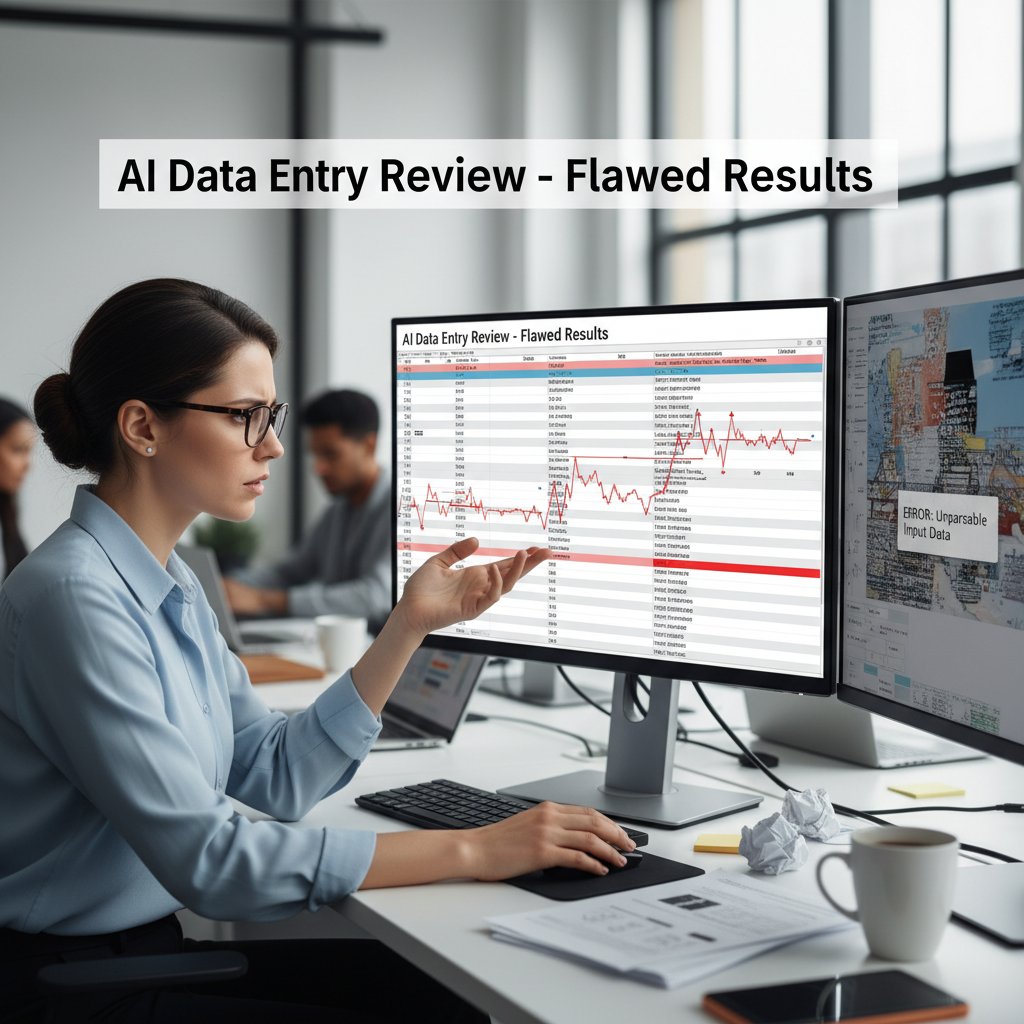
Relying solely on AI for mission-critical data entry is like letting a self-driving car navigate a maze of potholes and detours without a map. The best outcomes come from system designs that recognize the limits—and strengths—of AI, baking in continuous feedback and escalation paths.
Inside the machine: How AI-driven data entry really works
Step-by-step: From data ingestion to output
Let's get under the hood. Here’s how AI-driven data entry automation unfolds, from raw input to clean, actionable data:
- Data ingestion: Collect documents, images, and data from diverse sources (email, scanners, APIs).
- Pre-processing: Clean, standardize, and prep files—de-skew scans, fix orientation, remove noise.
- OCR processing: Extract text from images and scanned docs.
- NLP parsing: Analyze unstructured text, extract entities, classify content.
- Validation: Cross-check extracted data against reference tables, business rules, or databases.
- Human-in-the-loop review: Escalate ambiguous or low-confidence cases to human reviewers.
- Feedback loop: Corrections and validations are fed back to the AI for ongoing training.
- Output integration: Cleaned and validated data is delivered to downstream systems (ERP, CRM, analytics).
The power of this pipeline lies in its adaptability. Each stage can be tweaked, monitored, and improved—a far cry from brittle, single-shot automation scripts.
The role of training data, feedback loops, and bias
Data quality isn’t just “important”—it’s everything. Feed the AI junk, and you’ll get junk out, only faster and at scale. High-quality, representative training data is the difference between automation that masks problems and automation that solves them.

Feedback loops are the secret sauce. Every correction, exception, or validation—when captured—trains the system to get smarter. But beware: bias in the training data can hardwire systemic errors, leading to blind spots or even compliance violations. You can’t shortcut this stage. As Maya says:
"Bad data in, chaos out. There’s no shortcut." — Maya
Case studies: The messy reality of AI data entry in the wild
Success stories across industries
Healthcare, finance, retail—the battlefields of data entry automation are littered with both failures and legends. In healthcare, automating patient intake forms led to a 30% reduction in administrative workload and a noticeable boost in patient satisfaction, according to pre-verified scenario data. Before automation, staff spent 6+ hours daily entering handwritten notes; after, this dropped below two. The real win wasn’t just speed, but error reduction: medication orders transcribed via AI saw error rates fall by over 50%.

In finance, one investment firm’s journey was anything but linear. Their initial rollout floundered—the AI missed subtle cues in legacy Excel exports and misclassified transactions. But after retooling with more diverse training data and adding a review step, portfolio analysis improved by 25%, and turnaround time for reporting dropped from weeks to days.
Retailers are seeing similar jumps. Automating inventory data capture cut order fulfillment errors by 40%, and shelf stockouts dropped sharply as data was updated in real time. The lesson: AI delivers, but only when you invest in training, oversight, and flexible integration.
Failure files: When automation goes wrong
This isn’t a hero’s journey without casualties. Two of the most common failure modes: integration issues and compliance breakdowns. One mid-sized logistics firm tried to automate invoice scanning but failed to anticipate the variety of document layouts—leading to 20% of invoices being processed incorrectly. Another retail chain suffered a compliance breach when customer PII was inadvertently exposed due to insufficient data validation in the AI pipeline.
| Failure type | Cause | Impact | Lesson |
|---|---|---|---|
| Integration failure | Inflexible templates, legacy systems | 20%+ error rate, missed payments | Invest in robust mapping |
| Compliance breach | No PII filtering, weak validation | Data leak, regulatory investigation | Prioritize governance |
Table 2: AI-driven data entry failures—causes, impacts, and lessons. Source: Original analysis based on Workato, Microsoft, and UiPath/Statista.
For each disaster, there’s an alternate route: deeper integration testing, layered human review, or tighter compliance checks. The work isn’t in the launch; it’s in the relentless tuning after go-live.
Section conclusion: These stories—all messy, all real—prove that automation changes everything, but not always for the better. Survivors learn, adapt, and emerge stronger.
The human factor: Are jobs at risk or just evolving?
From data clerks to data curators: The new roles
The anxiety is real. Over 7.5 million data entry jobs are flagged for “automation risk” by 2027, according to World Economic Forum and Exploding Topics (2024). But here’s the less obvious shift: roles aren’t just disappearing—they’re evolving. The archetype has changed from pure data clerk to “data curator,” someone who manages, validates, and improves automation outputs instead of typing all day.
Timeline of AI-driven data entry automation evolution:
- Pre-2010: Manual data entry reigns; error-prone, slow.
- 2010-2015: Early RPA scripts handle most repetitive tasks.
- 2016-2019: OCR and first-gen AI start to parse unstructured data.
- 2020-2022: NLP and ML bring context and self-learning to automation.
- 2023: Generative AI triggers a 400% spike in automated workflows (Workato).
- 2025: Human roles center on oversight, quality assurance, and exception management.
Upskilling is the theme. Current data from Statista (2023) indicates at least 20% of enterprise employees require reskilling as AI is adopted. Those who make the transition find their roles richer—less about tedium, more about strategic impact.

Myth vs. reality: Is AI replacing jobs?
The fear of replacement is justified, but the numbers tell a subtler story. While jobs are being displaced, new roles are emerging at the intersection of tech and domain expertise. According to Business Insider (2023), AI is more likely to complement jobs, creating new opportunities in oversight and advanced analytics. After adopting AI automation, one data entry professional reported:
"I spend less time copying numbers, more time finding what’s missing or doesn’t make sense. It’s still data work, but more interesting." — Data entry specialist, post-AI adoption
This mirrors a broader workforce trend: jobs become more strategic, creative, and judgment-driven as automation sweeps away drudgery.
Section conclusion: The human factor isn’t vanishing—it’s moving up the value chain. Automation is the great leveler, but only for those willing to evolve.
How secure is AI-driven data entry automation?
Data privacy, compliance, and ethical landmines
Let’s slice through the utopian marketing: automating data entry means handling more sensitive data, faster, and at greater scale. This magnifies privacy and compliance risks. A single misconfigured pipeline can expose PII, trigger GDPR fines, or run afoul of industry-specific regulations.
| Industry | Key compliance requirement | Typical risk in automation |
|---|---|---|
| Healthcare | HIPAA, patient consent | Data leaks, unauthorized access |
| Finance | SOX, PCI DSS, KYC | Mishandled financial data |
| Retail | GDPR, CCPA, customer preferences | Exposure of PII |
Table 3: Compliance requirements and risks for AI-powered data entry across industries. Source: Original analysis based on Microsoft, UiPath/Statista, and McKinsey.
Actionable tips to reduce risk:
- Demand transparency about how your data is used, stored, and processed.
- Regularly audit your AI pipelines for vulnerabilities.
- Build in human review for sensitive or high-risk data flows.
- Restrict system access to trusted personnel and log every change.

Section conclusion: The compliance landscape is a minefield—ignore it at your peril.
Does automation make your data safer—or more vulnerable?
The answer is: it depends—on your controls, oversight, and vendor transparency. Automation reduces the risk of human error (fewer lost files, mistyped records), but it introduces new vulnerabilities: algorithmic bias, data leakage, and black-box decision-making. According to Gartner (2023), only 15% of strategic planning is automated, even though >50% could be, largely due to risk concerns.
Best practices—such as encryption, access logging, and continuous monitoring—can flip the script, making automated systems safer than the manual status quo. Industry leaders recommend a “defense in depth” approach: multiple layers of controls, regular audits, and a clear escalation path for detected anomalies.
Section conclusion: Automation can harden your data defenses or open new attack surfaces. The difference is strategy, not technology.
Getting started: Practical guides and checklists
Are you ready for AI automation? Self-assessment checklist
Before you dive in, check yourself (and your team) with this 8-point readiness audit. This is your early-warning radar—fail too many, and you’ll pay in pain later.
AI data entry automation readiness checklist:
- You have reliable, high-quality data sources (not just spreadsheets of chaos).
- Leadership supports process change and automation.
- IT has resources to manage integration and security.
- Staff are willing to retrain and adapt to new workflows.
- You understand your compliance obligations (GDPR, HIPAA, etc.).
- You have a process for handling exceptions and reviewing edge cases.
- There’s a plan for feedback collection and ongoing improvement.
- Your budget accounts for both initial rollout and ongoing tuning.
If you’re shaky on more than three, slow down and fix your gaps. Automation is not a “set and forget”—it’s an ongoing discipline.
Step-by-step guide: Implementing AI-driven data entry automation
Here’s your 10-step blueprint for launching (and surviving) AI data entry automation:
- Define clear goals: Know exactly what processes you want to automate and why.
- Assess data quality: Clean up sources, standardize formats, and fill in missing pieces.
- Map workflows: Document every step, exception, and handoff.
- Select your technology: Compare tools for fit, flexibility, and security.
- Start small: Pilot with a single process before scaling.
- Involve stakeholders: Engage end users, IT, and compliance from day one.
- Train the AI: Collect diverse, unbiased training data and validate outputs.
- Test and tune: Run parallel with manual processes, catch errors, and fix logic gaps.
- Monitor performance: Track accuracy, speed, and exceptions; adjust as needed.
- Iterate and scale: Expand to new processes, but keep improving the core system.
Common mistakes (and how to avoid them):
- Skipping data quality checks—your AI is only as good as your inputs.
- Failing to plan for exceptions—people will always find new edge cases.
- Neglecting compliance—regulators don’t care if your intentions were good.

Section conclusion: Implementation is a marathon, not a sprint. Resilience and flexibility win.
Comparing your options: Tools, services, and what to look for in 2025
The crowded landscape: What’s out there
If you’re shopping for AI-driven data entry automation tools, brace yourself—the landscape is sprawling. Standalone software gives you control but demands more setup. Cloud-based AI tools offer flexibility and updates but raise data residency questions. Hybrid solutions let you balance privacy and power.
| Tool/Service | Email integration | 24/7 availability | Custom workflows | Real-time analytics | Skill specialization |
|---|---|---|---|---|---|
| teammember.ai | Seamless | Yes | Full support | Yes | Extensive |
| Competitor A | Limited | No | Limited | Limited | Generalized |
| Competitor B | Limited | No | Limited | Limited | Generalized |
Table 4: Feature matrix comparing top AI data entry automation tools (2025 snapshot). Source: Original analysis based on public product documentation and user reviews.
What matters most isn’t feature lists—it’s integration, reliability, and support for your specific use case.
Section conclusion: The smartest buyers test for context fit—don't fall for slick demos.
teammember.ai and the rise of the AI-powered team member
Enter the era of the AI-powered team member. Platforms like teammember.ai aren’t just tools—they’re virtual colleagues, accessible via email and equipped with specialized skills. By slotting into your existing workflows, they erase the friction of learning new platforms and deliver real productivity gains without the overhead of extra hiring.
Seamless integration is the game-changer. When AI assistance is available right in your inbox, teams collaborate better, bottlenecks shrink, and the velocity of work explodes. As you evaluate providers, focus on:
- How easily does the tool fit into your current stack?
- Can it adapt to the quirks of your workflows?
- Is support responsive and knowledgeable?
Section conclusion: The future isn’t “AI or human”—it’s both, working side by side to crush bottlenecks and unlock new value.
What’s next? The future of AI-driven data entry and beyond
Emerging trends: From intelligent document processing to autonomous workflows
The most exciting developments in AI data entry are happening out of sight: intelligent document processing (IDP) that doesn’t just capture data, but understands and validates it; self-learning systems that adapt in real time; and the rise of hyperautomation—where end-to-end business processes run with minimal hands-on intervention.

These advances mean faster, more accurate, and more flexible data pipelines. But they also raise the stakes for governance and oversight, as mistakes can scale just as quickly as successes.
Section conclusion: The boundaries of what AI can do in data entry are expanding, but so are the risks.
Cross-industry impact: Adjacent applications and ripple effects
AI-driven data entry isn’t just changing back-office operations. It’s rippling into legal (contract analytics), insurance (claims processing), and logistics (shipment tracking). As organizations chase the holy grail of digital transformation, automation becomes the connective tissue, linking departments, breaking silos, and surfacing new insights.
This is more than a tech upgrade—it’s a reimagining of what work means in the digital era. Are we ready for a workplace where humans curate, coach, and correct AI systems instead of filling in blanks?
Section conclusion: The next decade will challenge every assumption about work, data, and the boundaries between human and machine.
Supplementary deep dives: Going beyond the basics
Intelligent document processing: More than just data capture
Intelligent Document Processing (IDP) is the next evolution, blending OCR, NLP, and workflow engines to “read,” understand, and act on complex documents. IDP transcends mere data extraction—it validates, classifies, and even routes information based on business logic.
Definition list:
- IDP (Intelligent Document Processing): End-to-end automation that ingests, classifies, extracts, and validates data from documents, handling complexity that basic OCR/RPA cannot.
- Entity extraction: Automatically pulling out people, places, numbers, and organizations from unstructured text.
- Document classification: Sorting incoming files by type (invoice, contract, application) using AI.
- Exception handling: Escalating ambiguous or incomplete documents to humans for resolution.
Three industry-specific use cases:
- Healthcare: Automating patient intake and insurance billing, with compliance checks built in.
- Finance: Accelerating loan application processing by verifying supporting documents in seconds.
- Legal: Parsing contracts and flagging unusual clauses for human review.
Section conclusion: IDP is where automation gets really smart—if you have the data discipline to back it up.
Common misconceptions and controversies in AI automation
Top 5 misconceptions:
- “AI can fully replace human judgment.” Reality: Humans are still vital for context and oversight.
- “Automation is always cheaper.” Hidden costs in setup, training, and ongoing correction can surprise you.
- “All tools are equally secure.” Vendor transparency and architecture differ wildly.
- “Error rates will drop to zero.” They fall but don’t vanish—new types of errors emerge.
- “Bias is just a ‘people problem.’” Not true—AI can magnify and perpetuate hidden biases in your data.
Controversies around “black box” AI, data bias, and lack of transparency are still raw. Real-world impact? Organizations face reputational hits, compliance fines, and operational headaches when they ignore these issues. The only way out is relentless testing, transparent procedures, and building trust—step by step.
Section conclusion: Automation is only as strong as your vigilance. The debate isn’t going away—own it, or risk being blindsided.
Conclusion: The new rules of data entry in an AI-first world
AI-driven data entry automation isn’t a wave you can ignore or ride without effort. It’s a force that exposes weaknesses, challenges comfort zones, and rewards those who adapt. Today’s brutal truths—displacement, bias, complexity—are the price of progress. But the hidden wins—precision, speed, liberated talent—await those willing to do the hard work of integration, oversight, and continuous learning. The new rules: stay curious, stay critical, and never let hype blind you to the details. If you’re ready to turn automation into advantage, start with brutal honesty and finish with relentless iteration. The future of work isn’t AI alone—it’s you, your team, and your machines, finally pulling in the same direction.
Sources
References cited in this article
- Workato 2024 Automation Index(workato.com)
- Statista(statista.com)
- Exploding Topics(allaboutai.com)
- Gartner(blog.mandalasystem.com)
- Flair.hr(flair.hr)
- Adviser Society(advisersociety.com)
- Thoughtful.ai(thoughtful.ai)
- Deep Cognition(deepcognition.ai)
- Functionize(functionize.com)
- AscendixTech(ascendixtech.com)
- Hyland(hyland.com)
- WonderBotz(wonderbotz.com)
- Automation World(automationworld.com)
- Arion Research(arionresearch.com)
- Sofigate(sofigate.com)
- Forbes(forbes.com)
- Gartner(gartner.com)
- HyScaler(hyscaler.com)
- Microsoft WorkLab(microsoft.com)
- Greet Technologies(greettech.com)
- AscendixTech(ascendixtech.com)
- FDM Group(fdmgroup.com)
- Robylon(blog.robylon.ai)
- Taloflow(taloflow.ai)
- Analytics Insight(analyticsinsight.net)
- Nature Human Behaviour(nature.com)
- IBM(ibm.com)
- Landbot.io(landbot.io)
- Datamatics(datamatics.com)
- AIMultiple(research.aimultiple.com)
- Accenture(newsroom.accenture.com)
- BLS(bls.gov)
- Forbes(forbes.com)
- IMF(imf.org)
- LinkedIn(linkedin.com)
- Medium(medium.com)
- SentinelOne(sentinelone.com)
- Microsoft Data Security Index(threatscape.com)
- ISACA(isaca.org)
- IBM(ibm.com)
Focus on what matters. Let AI handle the rest.
We know the feeling — another day starts with 50 unread emails, Ads Manager begging for attention, CRM out of date, and meetings without follow-ups. That's why we built TeamMember.ai — an AI team member that takes over all the operational work at the computer. Has its own email address and SMS number. Manages your inbox, runs Meta Ads, updates CRM, processes meetings, monitors social media, generates morning briefings, and controls the browser. Built on OpenClaw — a leading open-source AI agent — with cross-session memory and secure-cloud architecture that keeps your data safe.
Get startedBe First to Try Your AI Team Member
Every week without automation is dozens of hours lost to operational work. Hours you'll never get back. Join the waitlist and get priority access.
Frequently Asked Questions
How many data entry jobs are at risk of automation by 2027?
According to the World Economic Forum and Exploding Topics (2024), over 7.5 million data entry jobs are at risk of automation-driven displacement by 2027.
What percentage of respondents agree that AI delivers significant gains in accuracy and productivity for data entry?
According to UiPath/Statista (2024), 85% of respondents agree that AI delivers significant gains in accuracy and productivity in data entry.
What are the hidden costs of manual data entry beyond just time spent?
Beyond wasted hours, hidden costs include errors that ripple through financial reports and compliance filings, the cost of fixing mistakes, managing exceptions, and firefighting downstream disasters caused by data entry mistakes.
Is AI-driven data entry automation presented as a simple solution?
No; the article states that automated data entry is far from a frictionless fix and is disruptive, often misunderstood, and hiding both significant upside and downside that vendors typically don't disclose.
From the Archive
Explore more from AI Team Member

AI-Powered Task Automation: What Works and What Fails
AI-powered task automation is reshaping work. This article examines the real gains, the operational risks, and which automation strategies actually succeed.

AI-Based Workflow Automation in 2026: Risks, Wins, and What to Do Now
Discover insights about AI-based workflow automation

AI-Powered Virtual Assistant for Data Entry: Benefits and Real Risks
AI-powered virtual assistant for data entry offers real benefits alongside genuine risks. This article examines both the genuine gains and the pitfalls organizations encounter.

What Automatic Data Processing Tools Actually Deliver and Cost
Automatic data processing tools balance efficiency gains against hidden costs and workflow disruptions. This article examines the trade-offs, real-world risks, and practical considerations for implementation.

Automated Task Management: Which Tasks Should You Automate
Automated task management is transforming how work gets done. This article explains which tasks benefit from automation and which require human judgment.

AI Administrative Support in 2026: Power, Risks, and Real Wins
Discover insights about AI administrative support


