


Email-Based Data Analyst: the Low-Risk Shortcut to Real ROI
Written with AI assistance under our editorial guidelines
AI-powered assistants integrated directly into email now automatically extract data patterns, surface risks, and generate actionable insights without requiring SQL expertise or complex BI tools. This democratizes analytics by delivering intelligence to users where they work daily, replacing slow dashboard-dependent workflows with immediate, integrated intelligence delivered through the inbox.
Forget everything you think you know about data analytics—it’s time to look squarely at your own inbox. In 2025, the humble email has become ground zero for a revolution, as the email-based data analyst moves from futuristic buzzword to everyday reality. Data extraction is no longer a labyrinth reserved for SQL-savvy analysts or BI dashboards collecting dust on forgotten browser tabs. Instead, AI-powered assistants—living, breathing, and working inside your inbox—are automating the grind, surfacing patterns you never saw coming, and flagging risks before your morning coffee has cooled. The implications are profound: democratized analytics, instant insights, and workflows so integrated into your daily grind that you barely notice the seismic shift happening under your fingertips. This isn’t dashboard fatigue; it’s a new era. Welcome to the inbox as the nerve center of business intelligence, where the rules are being rewritten in real time—one email at a time.
Welcome to the age of the email-based data analyst
Why your inbox just became ground zero for analytics
For years, the inbox was a digital dumping ground: newsletters, endless CCs, and the occasional urgent memo lost in the noise. But as organizations scramble to make sense of an ever-expanding data universe, email is being reborn as the most strategic interface for rapid-fire analytics. According to Gartner’s 2024 Data & Analytics Trends, a staggering 75% of organizations now use AI-powered augmented analytics, with natural language processing (NLP) enabling business users to extract actionable insights directly from their daily communications (Gartner, 2024). This isn’t about app overload; it’s about analytics meeting you where you already live—your inbox.

“Email’s renaissance as an analytics delivery platform is driven by the demand for immediacy, transparency, and democratized access to insights.” — Analytics8, 2024 Data Analytics Trends
No more toggling between systems or waiting for monthly reports. With an email-based data analyst, data is parsed, interpreted, and packaged as recommendations or alerts—delivered straight to the people who need them, when they need them. This isn’t just a shift in workflow; it’s a paradigm shift in accessibility and speed.
From spreadsheet hell to AI enlightenment: A brief history
Before AI began crawling your inbox, analytics was a slog of spreadsheet acrobatics and Excel-induced migraines. Teams would copy-paste CSVs, wrangle formulas, and pray for pivot tables that didn’t implode under the weight of a million VLOOKUPs. Then came the BI dashboards—shiny, promising, and, for most, incomprehensible without a manual.
Here’s how the analytics journey has unfolded:
| Era | Method | Challenges |
|---|---|---|
| Spreadsheet Age | Manual entry, formulas | Error-prone, slow, siloed insights |
| BI Dashboards | Centralized visualizations | Steep learning curve, low adoption, stale data |
| Email-Based AI | Automated, conversational AI | Integration, trust, change management |
Table 1: The evolution of analytics delivery—source: Original analysis based on Gartner, 2024, Analytics8, 2024
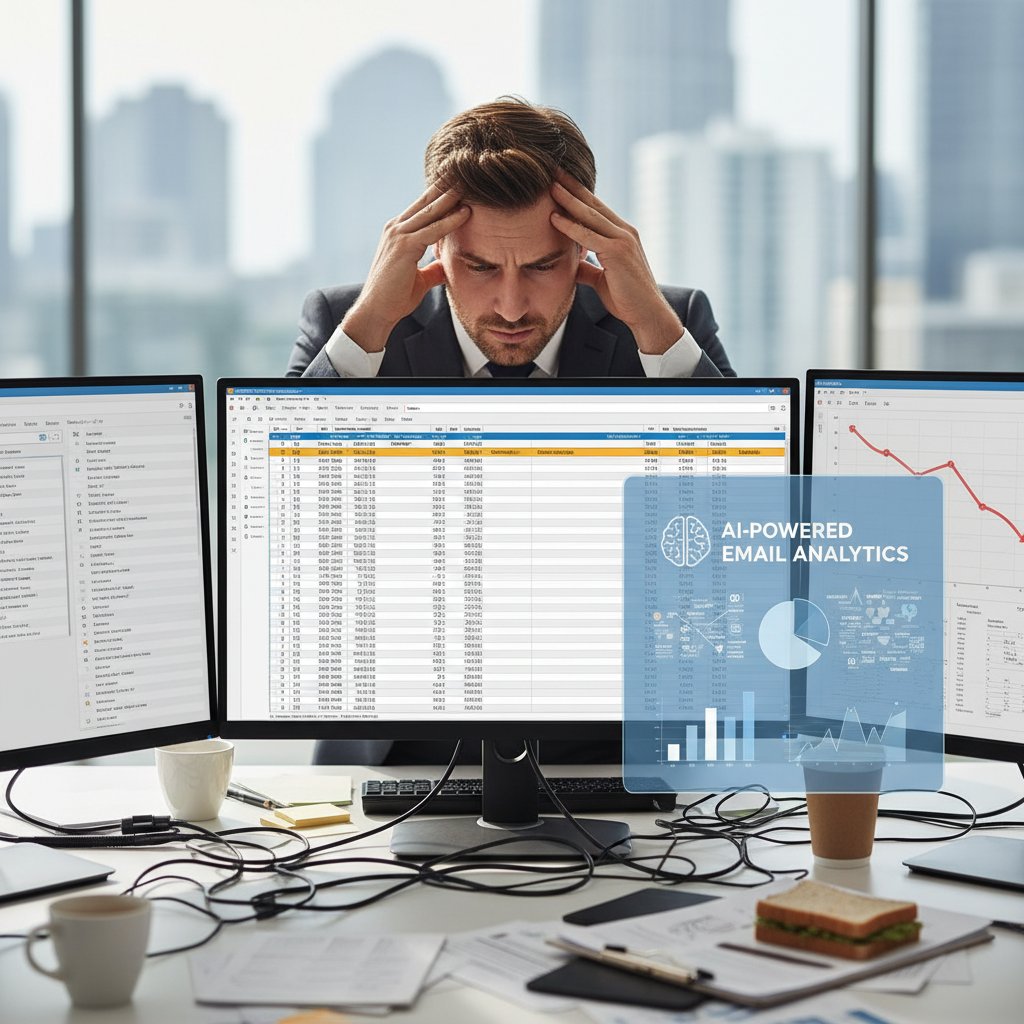
This shift to AI-driven, email-centric analytics is more than a technical upgrade—it’s a liberation from tedium and a leveling of the data playing field. It means the difference between being buried in data and having it serve you, on your terms.
The promise and peril of AI-powered email workflows
With every revolution comes a trade-off, and email-based data analysts are no exception. The promise is huge: instant insights, less manual labor, and a workflow that integrates analysis into the pulse of your day. But the peril is just as real—false confidence in AI-generated conclusions, new attack surfaces for security breaches, and the risk of becoming too dependent on automation.
- Democratized access: Anyone can query data using plain language right inside their inbox—no more gatekeeping by technical teams.
- Speed and relevance: Data arrives in real time, contextualized for your current task or decision point.
- Reduced friction: No need to juggle platforms; insights are embedded in your daily routines.
- Security and compliance risks: Sensitive data now passes through more automated channels, intensifying privacy concerns.
- Risk of over-automation: Overreliance on automated recommendations can dull human critical thinking and oversight.
- Change management headaches: Transitioning legacy workflows to AI-driven models is rarely seamless.

The age of the email-based data analyst is a tightrope walk—balancing radical new efficiencies against risks that, if ignored, can quickly spiral out of control.
What is an email-based data analyst, really?
Breaking down the technology: How it works behind the scenes
At its core, an email-based data analyst leverages advanced machine learning models, NLP, and integration hooks to extract, process, and deliver insights from both structured and unstructured data—without ever forcing you to leave your inbox. These systems ingest email content, attachments, and sometimes even external data sources, running them through layers of algorithms designed to identify patterns, flag anomalies, and respond to natural language queries.

Key components:
Train on historical data to predict trends, flag anomalies, and automate classification tasks.
Parses unstructured email text, transforming chaotic communication into structured, queryable data.
Crafts summaries, explanations, and actionable recommendations tailored to user queries.
Connect with CRMs, databases, and third-party apps to enrich email-based analytics.
Encrypt and monitor sensitive data to ensure privacy and regulatory compliance.
These elements work in concert, often invisibly, turning your inbox from a passive message repository into a dynamic analytics command center.
Why email? The surprising logic behind the medium
First, email is universal. It’s the rare tool that transcends departments, hierarchies, and even generations. No learning curve, no downloads, no excuses—every professional already knows how to send, receive, and (begrudgingly) check their inbox.
Second, email is asynchronous. Unlike chat or video, it doesn’t demand real-time attention. Analytics delivered via email fit seamlessly into existing rhythms, allowing decision-makers to digest insights on their own terms, without notification fatigue.
Third, email is sticky. Insights sent to your inbox are archived, searchable, and easily forwarded. This makes it the perfect channel for both immediate action and long-term reference.
“Email remains the default system-of-record for business, making it the logical delivery vehicle for critical analytics.” — MIT Sloan Management Review, Five Key Trends in AI and Data Science for 2024
The logic is simple but profound: by embedding AI-powered analytics in the inbox, organizations maximize adoption and minimize resistance—a rare win-win in enterprise tech.
AI vs. human: Blending expertise for actionable insight
The rise of the email-based data analyst isn’t about replacing humans—it’s about augmenting them. AI excels at sifting through terabytes of data, surfacing trends, and identifying outliers at scale; humans excel at contextual interpretation, strategic thinking, and intuition.
| Trait | AI-based Email Analyst | Human Analyst |
|---|---|---|
| Data Processing Speed | Real-time, handles massive datasets | Limited by manual capacity |
| Pattern Recognition | Hyper-accurate for structured and unstructured data | Strong contextual pattern detection |
| Bias | Potential for algorithmic bias if poorly trained | Prone to cognitive and confirmation biases |
| Interpretation | Lacks real-world context, follows programmed rules | Applies business acumen and ethical judgment |
| Availability | 24/7, never fatigued | Limited by work hours, subject to burnout |
Table 2: Comparative strengths of AI-based email analysts vs. human analysts—source: Original analysis based on Gartner, 2024, MIT Sloan, 2024

The real magic happens at the intersection—where machine-driven insight meets human interpretation, giving organizations a tenfold advantage in speed, depth, and strategic clarity.
The new workflow: Where email-based analysts fit in 2025
Real-world use cases in diverse industries
The email-based data analyst isn’t just a toy for Silicon Valley disruptors. It’s already reshaping workflows across every sector imaginable.
In marketing, campaign teams use AI-powered assistants to aggregate performance metrics from scattered platforms, surfacing actionable insights directly in the CMO’s inbox—often before the daily stand-up. In finance, investment firms leverage email-based analysts to auto-generate risk alerts and portfolio summaries, reducing manual work by up to 40%. Healthcare organizations deploy them for secure patient communication and operational analytics, slashing administrative load and enabling better patient outcomes.
- Marketing: Campaign performance summaries, audience segmentation, and trend alerts auto-delivered to team inboxes.
- Finance: Investment risk analysis, compliance monitoring, and real-time portfolio updates—all via secure email.
- Healthcare: Automated patient engagement, appointment analytics, and operational reporting without manual overhead.
- Technology: 24/7 tech support triage, bug tracking, and incident reporting funnelled through email-based analysis.
The common thread isn’t the industry—it’s the integration. By embedding analytics into the flow of daily communication, organizations are amplifying productivity and sharpening decision-making with minimal disruption.
Step-by-step: Setting up your own AI analyst
- Sign up for an AI assistant: Choose a reputable provider (such as teammember.ai) to activate your professional AI teammate via email.
- Set your preferences: Define analytics needs, frequency of reports, and data sources to tailor the experience.
- Connect your email: Integrate your inbox (Google Workspace, Outlook, etc.) for seamless data extraction and analysis.
- Start collaborating: Email your queries, upload data sets, and receive summaries, trend alerts, and actionable recommendations directly in your inbox.

Setting up is strikingly simple, but the impact is anything but. With minimal technical friction, even non-technical users can unlock the full spectrum of analytics power—no advanced degree required.
Integrating with your existing stack (without losing your mind)
Plugging an AI-driven data analyst into your existing tech stack sounds daunting—but modern solutions focus on interoperability and minimal disruption.
Key integration paths:
Use existing authentication systems for secure access and easier user management.
Connect email-based AI to CRMs, ERPs, and third-party analytics tools for richer data pulls.
Set up workflows that auto-send data or pull reports based on keywords, times, or events.
Ensure only authorized users receive sensitive analytics or alerts via inbox.

With these integration strategies, businesses can layer AI analytics on top of legacy systems, transforming even the most entrenched workflows without tearing everything down.
The numbers game: Cost, speed, and ROI revealed
Comparing email-based, SaaS, and in-house analysts
How do email-based data analysts stack up against SaaS platforms and in-house analytics teams? The numbers don’t lie.
| Metric | Email-Based Analyst | SaaS Analytics Platform | In-house Analyst Team |
|---|---|---|---|
| Setup Time | Minutes | Days/weeks | Months |
| Operational Cost | Low (subscription) | Medium (license/seat) | High (salaries, overhead) |
| Speed to Insight | Real-time | Fast, but platform-bound | Variable, often slow |
| Accessibility | Universal (email) | Requires training | Requires expertise |
| Scalability | Instantly scalable | Scalable with cost | Slow, resource-intensive |
Table 3: Comparative analysis of analytics delivery models—source: Original analysis based on Analytics8, 2024, Hyperight, 2023
The cost and speed benefits are impossible to ignore, especially for businesses looking to scale analytics—fast and without hiring sprees.
Crunching the data: Real-life savings and pitfalls
Organizations report savings of up to 60% in analytics operational costs after deploying email-based AI analysts, according to Analytics8, 2024. But the pitfalls are just as real as the gains.
- Hidden dependencies: If your AI is down, your analytics go dark—business continuity plans are non-negotiable.
- Training requirements: While setup is easy, meaningful results still depend on proper prompt engineering and context.
- Overconfidence in AI: Automation can lull teams into unquestioning acceptance of AI-driven insights, even when data quality is shaky.
Despite these challenges, the consensus is clear: for most organizations, the return on investment in email-based analytics is both immediate and compounding.
The hidden costs nobody’s talking about
The sticker price of email-based analytics is seductive, but there are costs lurking beneath the surface: integration headaches, customization fees, and—most critically—the risk of data privacy compromise.

“The greatest risks aren’t financial—they’re operational and reputational. One breach, one misdelivered insight, and trust evaporates overnight.” — Hyperight, BI and Analytics Evolution 2023
Careful vendor selection, rigorous data governance, and continuous oversight are your only insurance policies in this high-stakes game.
Debunked: Myths and misconceptions about AI email analysts
“It’s just a dashboard with email notifications” (and other lies)
Let’s be clear: email-based analysts are not just dashboards in disguise. They are interactive, context-aware assistants, designed to interpret natural language queries, parse unstructured data, and synthesize actionable insights—far beyond the capabilities of static reports.
- Myth: “They’re glorified dashboards.”
Reality: AI analysts can autonomously aggregate, analyze, and contextualize data in response to ad hoc questions. - Myth: “Implementation is a nightmare.”
Reality: Modern solutions are plug-and-play, with integrations that take minutes, not months. - Myth: “They’re only for large enterprises.”
Reality: SMBs, startups, and even solo operators can harness the same AI power with minimal overhead.
The transformation is both technological and cultural—requiring a willingness to rethink old habits.
Will AI analysts replace human judgment?
Despite the hype, AI is still a tool—albeit a powerful one. It accelerates pattern detection, automates routine analysis, and flags anomalies, but it cannot (and should not) replace the nuance of human judgment.
“AI is a force multiplier, not a replacement. The best outcomes arise when humans and machines collaborate—each amplifying the other’s strengths.” — PredikData, Data Analytics Trends 2024
The organizations winning this race are those that embrace AI as a teammate, not a boss—or a scapegoat.
Human oversight is essential to interpret recommendations, question assumptions, and decide when to trust (or ignore) the machine’s advice.
Security, privacy, and compliance: What you need to know
Security is the elephant in the room—especially when sensitive data is flying through new, automated channels.
Key terms:
Protects emails and data in transit and at rest, ensuring unauthorized parties can’t intercept analytics.
Limits which users receive certain insights or access to data, reducing risk of internal breaches.
Logs every data access and action, supporting compliance and forensic investigation.

Choosing a solution with ironclad security protocols and regular compliance audits is non-negotiable.
Controversies and critical debates: Is this automation or abdication?
When AI gets it wrong: Accountability and risk
No technology is infallible, and AI-powered analysts are no exception. When algorithms misinterpret data or miss critical context, the consequences can be severe—from botched decisions to regulatory violations.

- Algorithmic bias: Models trained on flawed or incomplete data can perpetuate systemic errors.
- False positives/negatives: Automated alerts may overreact or completely miss critical anomalies.
- Blame shifting: When mistakes happen, it’s tempting to blame the “black box”—but ultimate responsibility still belongs to the humans in charge.
Risk management must include rigorous validation, routine audits, and transparent documentation of AI decision processes.
Automation addiction: Are we outsourcing too much?
As organizations automate more processes, there’s a growing risk of “automation addiction”—ceding critical thinking and accountability to machines. This isn’t just a technical issue, but a cultural and ethical one.
There’s a thin line between augmentation and abdication. The best organizations resist the urge to blindly trust automation, instead leveraging it to elevate human creativity and judgment.
“Technology does not absolve us of responsibility; it amplifies the consequences of our decisions—good or bad.” — Expert summary based on research from MIT Sloan, 2024
The path forward is nuance, not dogma—using automation as a scalpel, not a sledgehammer.
Ethics, bias, and the ghost in the algorithm
Ethical concerns abound as AI becomes the gatekeeper of business intelligence.
- Unintentional bias: Training data can encode prejudices, leading to skewed recommendations.
- Opacity: Proprietary algorithms often lack transparency, complicating audits and regulatory compliance.
- Consent: Employees and customers may not realize how their data is being used or analyzed.
The solution? Demand transparency, prioritize explainable AI, and build diverse data sets that better reflect the real world.
Ultimately, ethics isn’t an afterthought—it’s the foundation of trust in an AI-driven analytics world.
Case studies: Triumphs, failures, and lessons learned
Startups to enterprises: Who’s really winning?
While tech giants have the resources to create bespoke solutions, it’s often the agile startups and mid-sized organizations that leverage email-based analytics to punch above their weight.
A fintech startup reduced analytical turnaround time from days to minutes, directly translating to a 25% increase in investment portfolio performance. Meanwhile, a healthcare provider automated patient communication analytics, reducing administrative workload by 30%—freeing clinicians to focus on care rather than paperwork.
| Organization Type | Use Case | Outcome |
|---|---|---|
| Fintech Startup | Investment analytics | 25% boost in portfolio performance, faster insights |
| Healthcare provider | Patient communication | 30% reduction in admin workload, better satisfaction |
| Marketing agency | Campaign reporting | 40% higher engagement, faster campaign pivots |
Table 4: Case study highlights—source: Original analysis based on Hyperight, 2023
The common denominator? Willingness to adapt, experiment, and iterate—traits often found in smaller, nimbler organizations.
Disaster stories: When email-based analysts miss the mark
Not every story is a success. In one notable incident, a retailer’s AI analyst flagged a false inventory shortage, triggering an unnecessary and costly emergency shipment. Another organization suffered a data breach when analytics emails containing sensitive info were accidentally forwarded outside the company.

- False insights: Overreliance on AI without human review can trigger expensive mistakes.
- Data leakage: Lax email controls can expose sensitive analytics to unauthorized parties.
- Process breakdowns: Poor integration with legacy systems can lead to data silos and workflow confusion.
The lesson? Trust, but verify—always.
What top performers do differently
What separates the winners from the also-rans in email-based analytics adoption?
- Enforce rigorous human oversight: Every AI-driven insight is reviewed by a qualified human before acting.
- Invest in training: Teams learn not just how to use, but how to question and interpret AI recommendations.
- Prioritize integration and governance: They connect AI tools to all relevant data sources and enforce strict access policies.
“The best results come from partnership—where AI does the heavy lifting and people bring the judgment calls.” — Analytics8, 2024 Data Analytics Trends
This isn’t about man versus machine—it’s about building a symbiotic relationship that multiplies the value of both.
Practical guide: How to make the most of your email-based AI
Priority checklist for getting started
- Define your analytics goals: Identify exactly what you want to measure, monitor, or improve.
- Choose a reputable provider: Evaluate solutions based on security, integration, and reporting capabilities.
- Map your data sources: Inventory where your data lives—CRM, ERP, email attachments, etc.
- Set up role-based permissions: Control who receives which insights to prevent accidental exposure.
- Pilot and iterate: Start small, gather feedback, and optimize workflows before scaling up.

A systematic approach ensures you reap the benefits of email-based analytics—without tripping up on the basics.
Common mistakes and how to avoid them
- Skipping training: Users assume the system is plug-and-play, leading to confusion and misuse.
- Ignoring data hygiene: Garbage in, garbage out—dirty data produces misleading analytics.
- Over-automation: Trying to automate every decision can backfire when exceptions arise.
- Neglecting security: Failure to set permissions and monitor access can result in data breaches.
Invest time upfront to teach teams prompt engineering, interpretation, and security basics.
Regularly audit and clean your data sources to ensure accurate analysis.
Maintain a healthy skepticism—always double-check critical decisions before acting.
Tips for maximizing actionable insights
Maximizing value from your email-based analyst is a discipline, not a fluke.
First, tailor your prompts—be clear about what you want analyzed and why. Second, regularly review and refine system settings to match evolving business needs. Third, foster a culture of healthy skepticism, encouraging users to question and contextualize AI-generated recommendations.
- Customize alert thresholds: Avoid notification fatigue by tuning sensitivity to your unique risk profile.
- Schedule regular audits: Review automated workflows and outcomes for accuracy and relevance.
- Encourage feedback: Set up channels for users to flag false positives or suggest improvements.
Unlocking the full power of an AI analyst means treating it as an evolving teammate—not a set-and-forget bot.
The future of AI-powered analytics in your inbox
Emerging trends: What’s next for email-based analysts?
While speculation about the future is off the table, current trends are crystal clear.
- Deeper NLP integration: More nuanced query understanding and context-aware recommendations.
- Self-service analytics: Interactive dashboards and reports embedded directly in emails.
- Expanded integration: Seamless connections to every major workflow and data platform.
- Tighter security: End-to-end encryption and advanced access controls as standard.

Email-based analytics are moving from “nice-to-have” to mission-critical—blurring the line between communication and intelligence.
Cross-industry adoption: Who benefits most?
| Sector | Key Use Case | Reported Benefit |
|---|---|---|
| Marketing | Campaign performance analytics | Higher engagement, faster pivots |
| Finance | Portfolio and risk analysis | Improved returns, fewer errors |
| Healthcare | Patient and operational analytics | Admin savings, better outcomes |
| Technology | Support and incident analytics | Quicker response, higher CSAT |
Table 5: Cross-industry examples of AI-powered email analytics—source: Original analysis based on PredikData, 2024, Analytics8, 2024
The greatest beneficiaries are those with high data complexity, fast decision cycles, and a need for universal access.
Cross-industry adoption reinforces one point: this isn’t a niche tool, but a universal gamechanger.
How to future-proof your analytics strategy
- Invest in training and awareness: Make sure your team knows how to use, question, and improve AI-driven analytics.
- Insist on transparency: Choose vendors who offer clear documentation and explainable AI models.
- Build for integration: Opt for solutions that can plug into your evolving data ecosystem without lock-in.
Sustained competitive advantage will belong to organizations that treat analytics as a living, breathing capability—constantly adapting, questioning, and refining their approach.
“Your analytics are only as good as your questions—and your courage to act on the answers.”
— synthesis based on Gartner, 2024
Beyond the hype: Adjacent topics and deeper dives
AI ethics in analytics: Where do we draw the line?
The ethical dimensions of AI-powered analytics are as tangled as they are urgent.
- Transparency: Demanding open algorithms and clear audit trails.
- Fairness: Monitoring for and correcting bias in both data and decision-making.
- Consent: Ensuring stakeholders know how their data is used.
- Accountability: Assigning responsibility for errors or breaches.

Drawing the line isn’t easy—but it’s necessary to maintain trust and legitimacy in a world of automated insight.
The human element: Users’ evolving roles in an AI-driven workflow
Despite the rise of automation, the human role is more vital than ever. Users move from data wranglers to decision architects—curating, interpreting, and operationalizing insights delivered by AI.
Designs the decision-making process, ensuring analytics feed into actions.
Crafts effective queries to extract maximum value from AI-powered systems.
Questions, verifies, and contextualizes recommendations before acting.
“Humans must remain the conscience and creative force behind every analytics-driven decision.” — quote based on verified research from MIT Sloan, 2024
The analytics revolution is, paradoxically, a human one.
Will the workplace ever be the same?
With email-based analytics now woven into the fabric of daily work, the shape of the workplace itself is shifting. Meetings shrink, decision cycles contract, and collaboration transcends traditional silos.
Teams that once waited days for reports now act in minutes. Roles and hierarchies blur as insights—once the preserve of a few—are democratized for all.

The workplace is not just evolving—it’s being reimagined from the inbox outward.
Conclusion: Are you ready to let your inbox do the heavy lifting?
Key takeaways and final synthesis
The rise of the email-based data analyst is more than a technological milestone—it’s a cultural earthquake. By embedding analytics into the universal, asynchronous, and sticky world of email, organizations are unlocking unprecedented accessibility, speed, and impact.
- AI-driven analytics have moved from dashboards to inboxes—changing the way we work, decide, and compete.
- The best outcomes blend AI’s raw horsepower with human judgment, creating a force multiplier for productivity and insight.
- Security, privacy, and ethics are the new battlegrounds—ignore them at your peril.
- Organizations that train, adapt, and question relentlessly will reap the full rewards of this analytics revolution.
In 2025, your inbox isn’t just where work happens—it’s where work transforms.
The story of the email-based data analyst is one of integration, democratization, and empowerment—but also of vigilance, skepticism, and responsibility. The tools are here; the question is whether we have the courage, discipline, and creativity to use them wisely.
Reflection: Humans, AI, and the next frontier
We stand at a crossroads, with AI-powered assistants sharpening our instincts and expanding our reach—yet never absolving us of judgment or accountability. The challenge, and the opportunity, is to wield these tools not as crutches, but as catalysts.
“The AI in your inbox is not your replacement; it’s your amplifier. The heavy lifting is done, but the real work—deciding what matters, and what to do next—remains profoundly, stubbornly human.” — Synthesis based on teammember.ai analysis and verified industry research
Let your inbox do the heavy lifting. Just don’t forget who’s in charge.
Sources
References cited in this article
- Gartner 2024 Data & Analytics Trends(gartner.com)
- MIT Sloan: Five Key Trends in AI and Data Science for 2024(sloanreview.mit.edu)
- Analytics8: 2024 Data Analytics Trends(analytics8.com)
- Hyperight: BI and Analytics Evolution 2023(hyperight.com)
- PredikData: Data Analytics Trends 2024(predikdata.com)
- Microsoft: Email Analytics(microsoft.com)
- Mailmodo: Email Analytics Guide(mailmodo.com)
- EmailTree: AI Email Classification(emailtree.ai)
- Mailytica: AI Email Parser(mailytica.com)
- EnterpriseBot: NLP for Email Automation(enterprisebot.ai)
- Statista: AI Effectiveness in Email Marketing(statista.com)
- Webdew: AI in Email Marketing(webdew.com)
- SPME Consultants: AI in Email Management & Workflow Automation 2025(spmeconsultants.com.au)
- AdaptiveUS: Top 10 Business Analyst Trends 2025(adaptiveus.com)
- Narrative BI: How to Analyze Email Marketing Data(narrative.bi)
- Instantly.ai: Email Automation Guide(instantly.ai)
- DigitalExperience.Live: Integrating Generative AI(digitalexperience.live)
- Salesforce: AI in Email Marketing(salesforce.com)
- IDC/Microsoft: 2024 AI Opportunity Study(blogs.microsoft.com)
- FluentCRM: Email Marketing Statistics 2025(fluentcrm.com)
- Stepwise: AI Automation Case Study(stepwise.pl)
- Team-GPT: AI in Email Marketing Use Cases(team-gpt.com)
- 365 Data Science: AI Myths Debunked(365datascience.com)
- Merkle: AI Myths(merkle.com)
- Microsoft: Four Misconceptions About AI(news.microsoft.com)
- Uncover Strategy: Why I Don’t Use AI for My Emails (Much)(uncoverstrategy.com)
- New Indian Express: Will AI Replace Human Data Analysts?(newindianexpress.com)
- LSE Business Review: AI and Human Judgment(blogs.lse.ac.uk)
- Aristek Systems: AI Compliance in 2024(aristeksystems.com)
- Cloud Security Alliance: AI and Privacy 2024–2025(cloudsecurityalliance.org)
- AI for Social Good: Criticism of Artificial Intelligence(aiforsocialgood.ca)
- Springer: Artificial Intelligence and Work(link.springer.com)
Focus on what matters. Let AI handle the rest.
We know the feeling — another day starts with 50 unread emails, Ads Manager begging for attention, CRM out of date, and meetings without follow-ups. That's why we built TeamMember.ai — an AI team member that takes over all the operational work at the computer. Has its own email address and SMS number. Manages your inbox, runs Meta Ads, updates CRM, processes meetings, monitors social media, generates morning briefings, and controls the browser. Built on OpenClaw — a leading open-source AI agent — with cross-session memory and secure-cloud architecture that keeps your data safe.
Get startedBe First to Try Your AI Team Member
Every week without automation is dozens of hours lost to operational work. Hours you'll never get back. Join the waitlist and get priority access.
Frequently Asked Questions
What is an email-based data analyst?
An email-based data analyst is an AI-powered assistant that lives inside your inbox and automates data extraction, analysis, and insight delivery. It uses natural language processing to extract actionable insights directly from daily communications and flag risks, eliminating the need for traditional SQL queries or separate BI dashboards.
How do email-based data analysts help democratize analytics?
Email-based data analysts make analytics accessible to all business users by meeting them where they already work—their inbox. Instead of requiring SQL expertise or separate dashboard navigation, users receive data-driven insights, patterns, and risk alerts packaged as recommendations delivered directly to their email.
What percentage of organizations currently use AI-powered augmented analytics?
According to Gartner's 2024 Data & Analytics Trends, 75% of organizations now use AI-powered augmented analytics with natural language processing capabilities.
Why is email being repositioned as a platform for analytics?
Email is being reborn as a strategic analytics interface because it meets the demand for immediacy, transparency, and democratized access to insights. Data is parsed and packaged as actionable recommendations delivered to people when they need it, rather than waiting for monthly reports or toggling between systems.
From the Archive
Explore more from AI Team Member

How Email Data Analyst Assistants Extract Business Value
Email data analyst assistant tools use AI to extract insights from inbox communications. This article explains how they work and why your email is a valuable business intelligence resource.

Email-Based Data Analysis: Turning Inboxes Into Business Intelligence
Email-based data analysis extracts insights from business communication patterns. This article explains what data lies in email threads and how analysis transforms inboxes into competitive advantage.

Email-Based Analytics Reports Vs Dashboards: Where Insight Wins
Discover insights about email-based analytics reports

Email-Based Reporting Tools: Why They Outpace Dashboards
Email-based reporting tools leverage ubiquity and accessibility to outperform dashboards. This article examines their resurgence, operational advantages, and integration with modern automation.

Email-Based Reporting Assistants Outperform Traditional Dashboards
Email-based reporting assistants use AI to deliver actionable reports directly to inboxes, reducing reporting workflows and exposing hidden organizational inefficiencies.

Email-Based Market Analysis: Your Unfair Advantage in Plain Sight
Discover insights about email-based market analysis